Ask ChatGPT, Gemini, Grok and DeepSeek the Same Question at Once

When you ask one AI chatbot a question, you get one confident answer and no good way to tell if it is right. So many people paste the same question into ChatGPT, then Gemini, then Grok, and read all the answers side by side. It works, but it is slow, and at the end you still have to find the differences yourself. Roundcall does the whole round for you and gives back one report. It is a free, open-source plugin for Claude Code, and it works through the chat websites you already use and are already signed in to, in your own Chrome browser. You need no API keys and no extra subscription.
What you get
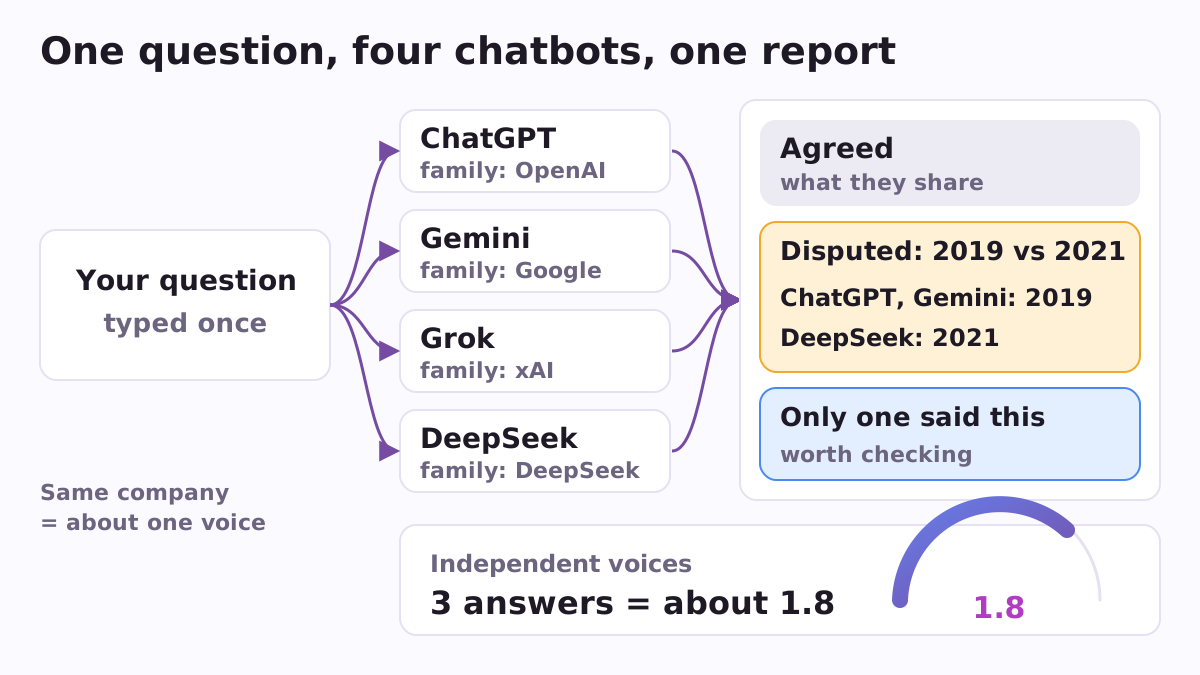
You type one question. Roundcall opens a tab for each chat site you have turned on, sends the question, waits until each answer stops changing, and reads it. Then you get a single report with:
- Bottom line: what the answers agree on and where they split.
- Who answered: each site, its company ("family"), how long it took and whether it worked. A site that wants you to sign in is marked and left open for you.
- Disputed: the points where the answers contradict each other, with every site's own words quoted next to its number or date.
- Single-source: things only one site said. That might be a find the others missed, or one model's mistake, so the report says it is worth checking.
- Independent voices: a rough count of how many separate opinions you really have. Two chatbots from the same company agree for the same reasons, so they count as about one. The README is clear that this number is an assumption, not a measurement.
Roundcall does not decide who is right. Every claim in the report comes with a word-for-word quote, and a script checks that the quote is really in that site's saved answer; claims it cannot prove are dropped. Claude's own view, if any, comes last, is labelled, and is never counted as a source.
A concrete example
You ask: "When was the Example Museum founded?" ChatGPT and Gemini say 2019, DeepSeek says 2021, and all three agree it began as a private collection. The report's bottom line says the founding year is disputed, 2019 or 2021, and shows who said which and the sentence each used. You now know exactly what to look up, instead of trusting whichever answer you read first.
How it behaves
Roundcall is built to work the way a person does. It keeps at least 8 seconds between opening tabs and 90 seconds between two questions to the same site, and it has a daily limit per site, 20 questions by default. Each site gets your question once and never sees another site's answer. It never types passwords or codes and does not touch CAPTCHAs; when a site needs you, it stops and says so. It runs only when you ask, never in the background. Only the question you typed is sent, and you see the exact text before it goes out. A safety guard watches the browser actions during a round and allows only the round's own tabs, only your question and only the sites you enabled. Whatever a site writes back is treated as plain information, never as instructions.
Eight sites are automated: ChatGPT, Gemini, Grok, DeepSeek, Mistral, Copilot, Qwen and Kimi. Others, such as Z.ai, Meta AI and ERNIE, can be added by pasting their answers in by hand. Nothing is turned on when you install; the setup asks which sites you want. A separate Chrome profile just for AI chats is recommended.
How to start
You need Claude Code, Google Chrome with the official Claude in Chrome extension connected to it, Python 3.9 or newer (nothing extra to install), macOS or Linux, and accounts you have already signed in to on the chat sites you want to ask. Then in Claude Code:
/plugin marketplace add vadimchernets/roundcall
/plugin install roundcall@roundcall
/roundcall:setup
/roundcall:ask When did the first transatlantic telegraph cable start working?
A quick round takes about 3 to 5 minutes. A deeper round, asked for only when you say so, takes about 15 to 30 minutes. Change settings in plain words with /roundcall:sites, for example "turn off grok". Each round is saved in ~/.roundcall/runs/ with the question, the answers, the checked claims and the report.
Roundcall, Sidecall or Duocall?
Roundcall is the browser member of a family of three plugins. All three ask AIs from different companies and keep their disagreements in view; they differ in where the other AIs live.
- Roundcall (this page) asks AI chat websites through tabs in your own Chrome, up to four sites per quick round, and needs no AI programs installed.
- Sidecall asks the AI command-line programs installed on your computer (Codex, Antigravity, Grok, Kimi) and writes the same kind of claim-by-claim report, with a critic for code and plans.
- Duocall asks one AI from one other company and compares it with Claude, in plain words, before a decision that matters. With no second program installed, it gives you the text to paste into a free browser chat yourself.
Roundcall is version 0.1, an independent open-source project under the Apache-2.0 licence, with 71 automated tests. To measure how much your AIs' agreement is really worth, see After Chat. The code is at github.com/vadimchernets/roundcall.
Vadym Chernets also builds Poly A1, an app in which AIs from different companies check each other's work.