Get a Second Opinion on Claude Code's Answer From Codex, Grok and Other AIs

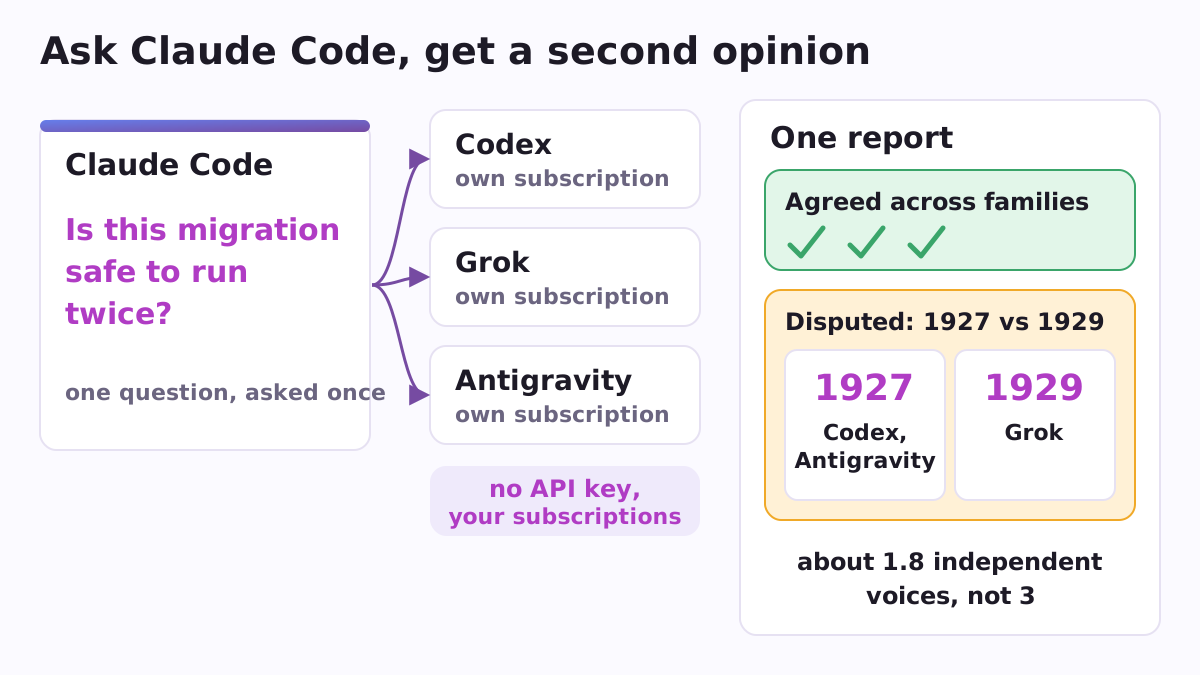
You ask Claude Code a question and get a confident answer. Is it right? The usual fix is to copy the question into another AI, wait, copy the answer back and read both by eye. Sidecall is a free, open-source plugin for Claude Code that does this in one command. It asks the other AI tools already installed on your computer the same question, each through its own official app and your own subscription, and brings back one report that shows what they agree on, where they contradict each other, and what only one of them said.
Why you would want it
A single AI can be wrong without any sign of doubt. A second AI from the same company tends to be wrong in the same way, because it learned from similar data. A model from a different company, such as Codex from OpenAI, Antigravity from Google, Grok from xAI or Kimi from Moonshot AI, misses different things. People already use this habit to review code: one model writes, another attacks it. Sidecall turns the habit into a command, and puts the proof in front of you instead of a summary you must take on trust.
What it gives you
Three commands cover most uses.
/sidecall:askasks every working tool, one per model family and up to four, and writes a report. Every claim in the report carries a quote from each tool's saved answer, and a script checks that each quote really appears in that answer./sidecall:secondasks one tool from a different family and compares its answer with Claude's own. Claude writes its answer first, so the other tool cannot sway it, and the other answer is shown word for word, not blended into Claude's./sidecall:criticsends a git diff, a file, a plan or Claude's last answer to a model from another family with orders to find what is wrong, then Claude answers each point and says which it accepts or rejects. Nothing is changed without your yes.
You can also just say "get a second opinion on that". Sidecall never starts on its own: it runs only when you ask.
A concrete example
Ask /sidecall:ask "In what year did Parliament first sit in Canberra?" and the report opens with a bottom line: Canberra has been the seat of Parliament since the 1920s. Under "Disputed" it shows the claim "Parliament first sat in Canberra in 1927", which Codex and Antigravity support, and Grok's quoted answer "1929". A line below tells you how many independent voices you really have: three usable answers count as about 1.8 voices, not 3. That figure rests on assumed correlations between model families (0.9 inside a family, 0.35 between families), not a measurement, and the report says so. You see at once which line needs checking and which parts all the tools share.
How it keeps your money and files in view
Before anything is sent, you see which tools will answer, which model each will use and the exact text. Sidecall uses no API keys: variables that look like keys, tokens or passwords are removed from the tools' environment, so answers come through your subscriptions. By default it picks economical models and tells you how to ask for stronger ones with --budget stronger. If your text looks like it contains a secret, it refuses to send it and names the line. Each tool starts in an empty scratch folder, not in your project, and a hard time limit stops every tool.
How to start
You need Claude Code on macOS or Linux, plus at least one other AI command-line tool signed in with your own account (Codex, Antigravity, Grok or Kimi). Inside Claude Code:
/plugin marketplace add vadimchernets/sidecall
/plugin install sidecall@sidecall
/sidecall:setup
/sidecall:setup runs once, finds the tools you have and shows one fix for anything missing. Then ask your first question.
Sidecall, Duocall or Roundcall?
Three sibling plugins share the same idea, that agreement between AIs from different companies is worth more than agreement inside one, but they reach the other AIs in different ways.
- Sidecall (this page) asks the AI command-line programs installed on your computer, up to four at once, and writes a claim-by-claim report with quotes. It also has a critic for code, files and plans. It suits people who already use tools like Codex or Grok in a terminal.
- Duocall asks one AI from one other company and compares it with Claude, in plain words, for a decision that matters: a contract, a sum, a deadline. If no second program is installed, it hands you the exact text to paste into a free chat in your browser. It is written for people who are not programmers.
- Roundcall asks AI chat websites, such as ChatGPT, Gemini, Grok and DeepSeek, by opening tabs in your own Chrome, and gives the same kind of report as Sidecall.
The code, the 68 automated tests and the full documentation are at github.com/vadimchernets/sidecall, under the Apache-2.0 licence. It works from the same ideas as the paper After Chat, whose teaching code is in After Chat. Sidecall is not affiliated with Anthropic, OpenAI, Google, xAI or Moonshot AI.
Vadym Chernets also builds Poly A1, an app in which AIs from different companies check each other's work.