Is My SSRN Download Count Good? A Free Benchmark by Paper Age and Field

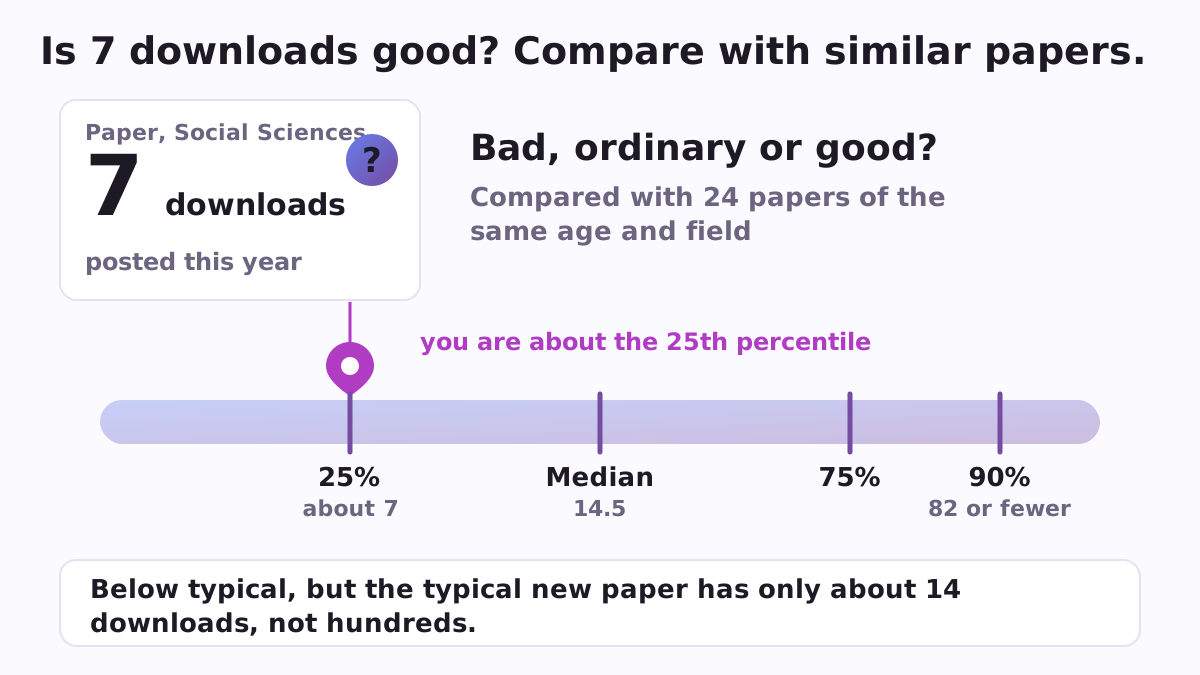
You posted a paper on SSRN. A few weeks later the counter shows 7 downloads. Is that bad, ordinary or good? Until July 2026 you could look at the SSRN Rankings and get a feeling for it. On 15 July 2026 SSRN retired its Rankings. Download counts stayed on every paper and author page, but the numbers they could be compared with are gone. SSRN Benchmark is a free, open-source tool that puts that comparison back. You give it your download count, the age of your paper and, if you like, your subject field. It tells you roughly what share of similar papers you are ahead of.
What it gives you
Run it and you get four things: your figure, the group of papers you were compared with, a percentile, and the typical range for that group (25%, median, 75%, 90% and 95%), with a plain verdict from "well below typical" to "well above typical". It can also print the whole reference table by age, a table of median downloads by field, and the list of the 25 available fields. If your count covers several papers, say so with --papers and it divides by that number.
The reference group is 1,360 SSRN papers, published between 1996 and 2026 across 25 fields. Their lifetime download counters were read from Internet Archive captures taken before SSRN stopped serving them to automated clients, so this snapshot cannot be collected again.
What the numbers say
Most authors expect more than the data shows. The median paper in its posting year has 12 downloads; the median at one to two years is 25, at two to five years 52, at five to ten years 130, and over ten years 172. Growth is concentrated in the first three or four years, when median downloads roughly double each year. After about five years the differences between age groups are not statistically significant.
Field matters nearly as much as age. For papers one to three years old, the median is 109 in Business, 71 in Social Sciences, 65 in Economics, 46 in Computer Science and 23 in Materials Science. So a count that looks poor in Business can be ordinary in Engineering. Always pass your field when you know it.
A concrete example
Say your paper is in Social Sciences, was posted this year, and has 7 downloads:
python3 ssrn_benchmark.py --downloads 7 --months 2 --field "Social Sciences"The tool compares you with 24 Social Sciences papers from the same age group, reports a percentile of about 25%, shows that the median there is 14.5 and that 90% of papers have 82 or fewer, and gives the verdict "below typical". It also notes that ignoring the field would have put you at about the 34th percentile instead. You learn that 7 is lower than most, but that the typical new paper has only a dozen or so downloads, and where to aim.
How to read the result
Every answer comes with a short note on how to read it. Papers with a surviving archive capture are over-represented, so trust the shape of the distribution more than the absolute levels. Download counters include automated traffic. Downloads are only weakly related to citations. Posting dates in the data carry only a year, so age is measured in whole years and no shorter band is offered.
How to start
You need Python 3. There is nothing to install, no account and no extra packages: download the two files, ssrn_benchmark.py and study1-wayback-downloads.csv, or clone the repository.
git clone https://github.com/vadimchernets/ssrn-benchmark
cd ssrn-benchmark
python3 ssrn_benchmark.py --table
python3 ssrn_benchmark.py --downloads 40 --months 24 --field Economics
The code is under the MIT licence and the data under CC BY 4.0, so you can reuse both. Everything is at github.com/vadimchernets/ssrn-benchmark. The data is archived on Zenodo (DOI 10.5281/zenodo.22285871), and the analysis behind it is the paper What Does 7 Downloads Mean? Metric Blindness and the Cold Start of Scholarly Attention After the SSRN Rankings Sunset by Vadym Chernets.
Vadym Chernets also builds Poly A1, an app in which AIs from different companies check each other's work.