Can AI Predict the Stock Market? A Council of AI Models: Daily Forecasts, Sealed and Scored
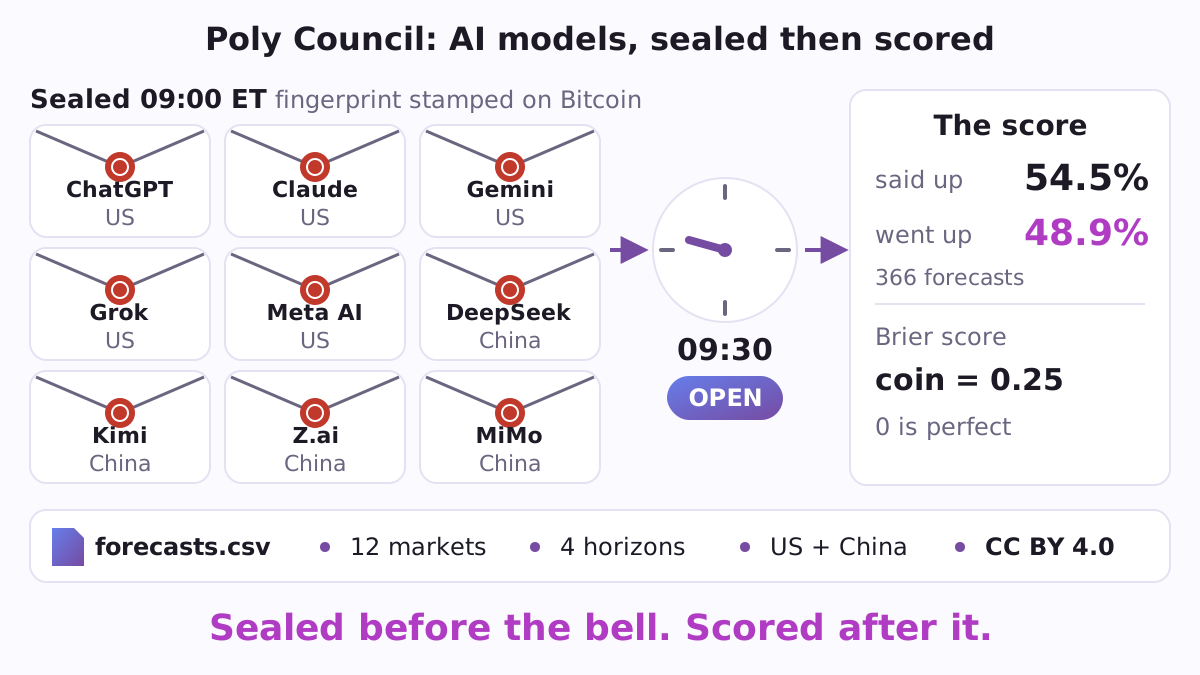
Poly Council is a free, open dataset that answers a question people type into Google every day: can AI predict the stock market? Instead of one chatbot's opinion, it collects the forecasts of a council of AI models from the United States and China every trading day, locks each day's answers before the market opens, and then scores them against what really happened. Everything is in plain spreadsheet files you can download, open and reuse.
The repository is at github.com/vadimchernets/poly-council. It is the open copy of the Poly Council on Poly Trends, and it updates itself once a day.
Why a sealed, scored record matters
Type "can ai predict the stock market" into Google and the next suggestions are "better than humans", "really" and "accurately". Others ask "is chatgpt good at predicting stocks" and "which ai is best for stock market". The honest way to answer is a record: the same questions, asked of many models, every day, written down before the result is known.
Studies show why the record has to be large. In a 2023 University of Florida study of ChatGPT and news headlines, the signal held up across many companies and days, while accuracy "for any single headline was only 51%" (Fortune). One lucky screenshot proves nothing. Thousands of sealed forecasts, scored one by one, do.
What is in the dataset
Every trading day the council gives a forecast for 12 markets:
- the S&P 500, the Nasdaq-100, the Dow Jones and the chip index;
- the 10-year US Treasury yield, the dollar index and the VIX "fear index";
- gold, WTI crude oil, Brent crude oil, copper and Bitcoin.
Each market gets four horizons: 1 day, 1 week, 1 month and 6 months. For each one, a model picks one of five calls (buy strong, buy dips, hold, trim, sell), gives the chance in percent that the price goes up, and the move it expects. The full daily file also keeps the model's reasons in plain words, the news links it used, a price target, the level at which it would change its mind, and the biggest risk it sees.
The council's line-up changes from day to day, so the league already holds many models: ChatGPT (GPT-6.1 Sol), Claude (Opus 5.5), Gemini (4 Argon), Grok (4.7), Meta AI (Muse Spark 1.3) and Nemotron from the US; DeepSeek (V4.1), Kimi, Z.ai (GLM-5.3), MiMo from Xiaomi, Step 5 Preview and Wenxin (ERNIE) from China. Each model's exact name and mode, such as "web search" or a high reasoning setting, is recorded with its answer, so "ChatGPT vs DeepSeek for trading" becomes something you can count, not argue about.
Sealed before the opening bell
Each morning the answers are sealed before the session: on 23 October 2026 the seal was made at 13:00 UTC (9:00 New York time), half an hour before the 9:30 open. A seal is a hash, a short fingerprint of the exact text: change one comma and the fingerprint changes. That fingerprint is stamped with OpenTimestamps, a free service that writes it into the Bitcoin blockchain, so nobody, including the authors, can quietly rewrite a forecast after the fact.
Each day's file links its proof page, for example the proof for 23 October. It has a "check in the browser" button that recomputes the fingerprint for you, and for those who like the command line, ots verify and openssl checks against three independent timestamp services.
How the scoring works
Two numbers tell you whether a model is any good.
Direction hit rate: how often an up or down call went the right way. A "hold" is not counted.
Brier score: a grade for the probability itself. If a model says "70% up" and the price goes up, it scores well; if it goes down, it pays for its confidence. Zero is perfect. A coin that always says 50% scores exactly 0.25, so any model above 0.25 is doing worse than a coin. The league also compares each model with the council's consensus.
In the league of 25 October 2026, after 55 resolved forecasts, Meta AI had the best Brier score (0.2144) and Z.ai the best hit rate (60.6% of 33 calls), while the council's consensus stood at 0.2486, just under the coin. A calibration table shows whether "60%" really means 60%: across 366 forecasts where the models said 50–60% up (54.5% on average), the price went up 48.9% of the time. No model is ranked with stars yet: the league ranks a model only after 30 resolved forecasts, and the history is still being collected.
How to start
You do not need to program to use it.
- Open the repository at github.com/vadimchernets/poly-council and go to the
datafolder. - Download
forecasts.csv. It holds every day in one table: date, market, horizon, model, the model's home country (US or CN), the call, the chance of a rise, the expected move, and the columns for the real move and the verdict. Open it in Google Sheets, Excel or Numbers. - Filter and compare. Pick "GOLD" and "1w" to see what every model said about gold for the week, or put the US models next to the Chinese ones. You can also hand the file to any AI chat and ask, "which model is most often right about Bitcoin?"
- Read the scores in
league.csvinside each dated folder (orleague.jsonfor the latest): resolved forecasts, hit rate, Brier score and stars for each model. - Go deeper with
council.jsonin a dated folder, the full issue of that day, with every reason, source, seal and quote.
If you have Node 18 or later, node scripts/export.mjs fetches the latest issue from the public Poly Trends feed and rebuilds the files, with no extra packages. The six dated issues so far, from 16 to 23 October 2026, hold 2,412 forecast rows, and a new folder arrives each day.
Free to reuse, with credit
The data is released under CC BY 4.0: you may share it, adapt it and use it for any purpose, including commercial work, as long as you credit "Poly Council open dataset, Poly Helper, https://trends.polyhelper.ai/". The exporter script is under the MIT licence. A CITATION.cff file gives the citation for papers: Poly Helper. Poly Council: daily AI market forecasts, seals and scores. There is no personal data: only model forecasts, prices and totals of reader votes.
That makes it useful well beyond curiosity: a teacher can show a class what calibration means with real numbers, a student can build a forecasting project on it, a researcher can use it as an LLM forecasting benchmark, and an investor can see which AI's market views have held up before asking one for an opinion.
Where it comes from
Poly Council is published by Poly Helper. The forecasts are made and scored live on Poly Trends, where each day's council, its seal and the running league are on one page, and in the Poly Helper app. The open data, the exporter and the licence are at github.com/vadimchernets/poly-council.
Vadym Chernets also builds Poly A1, an app in which AIs from different companies check each other's work.