Use ChatGPT and Claude Together on iPhone — One Tap, Two AIs Check Each Other
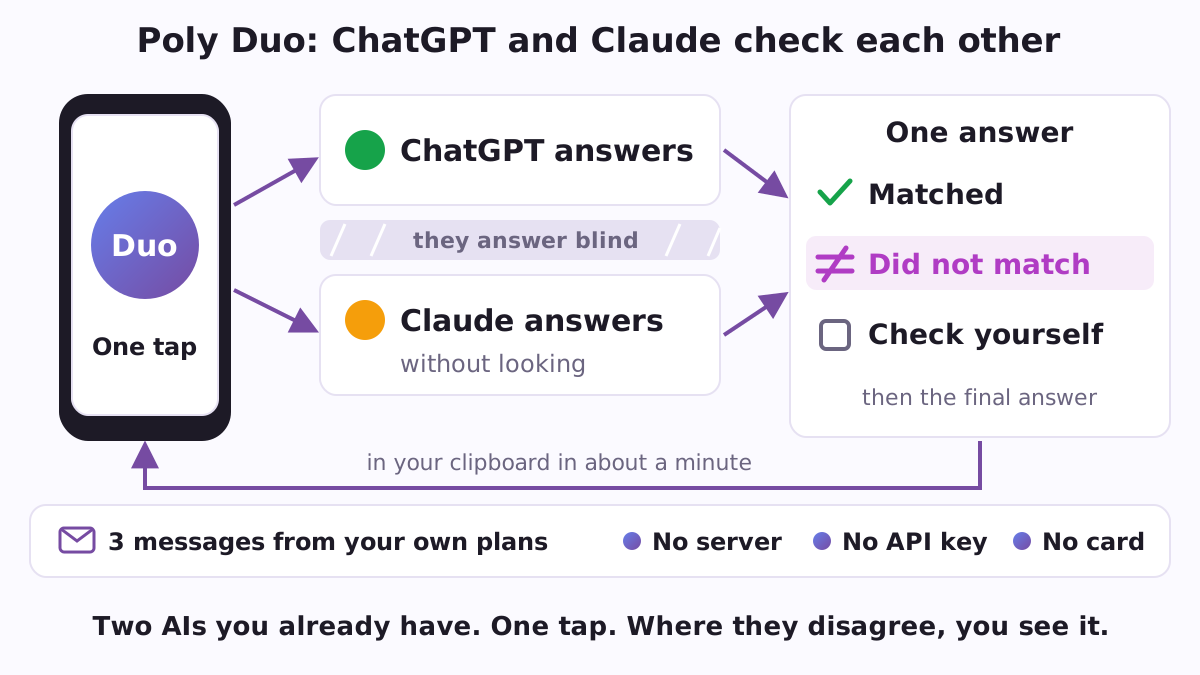
Poly Duo puts the two AIs you probably already have, ChatGPT and Claude, to work as a pair on your iPhone. You tap one button and type a question. ChatGPT answers. Claude answers the same question on its own. Then Claude compares the two and gives you one answer that opens with three short blocks: what matched, what did not, and what to check yourself. It lands on your screen and in your clipboard in about a minute.
It is free and open source. It runs on your own ChatGPT and Claude accounts, and free accounts are enough. There is no server in between, no API key (the access code programs use to call an AI), no card and no computer. On the phone it is simply called Duo; its README calls it C1M Duo.
Why ask two AIs instead of one
One AI answers everything with the same calm confidence, including the parts it gets wrong. A second AI from another company, answering the same question on its own, tends to slip in different places. So where the two answers part ways, you see exactly what to look at.
People already know they should check. In an April 2026 survey of 2,127 US adults, 78.5% had made a real-life decision based on an AI answer, but only 17.4% always checked it, and just 15% checked by asking a different AI (National Law Review). The usual way to do it is tiring: open ChatGPT, ask, copy, open Claude, paste, ask it to check, copy again. Duo does that whole round in one tap.
The project's own numbers show why the two have to be strong. When the August 2026 flagship models of OpenAI and Anthropic answered 1,459 factual questions separately and agreed, they were right 98% of the time (985 of 1,004). When two mid-tier models of the same companies agreed, only 37%. That is why Duo uses the main ChatGPT and Claude apps, with whatever model you have chosen in each.
What a run looks like
- Ask. Tap Duo, type or dictate the question, or select text in any app and send it through Share → Duo. The question box comes up already filled in.
- Pick a mode. The default is ⚖️ Critique, and it is all you need on the first day. Each mode shows its price in messages (✉) before you choose; Critique costs 3.
- Put the phone down for about a minute. The phone opens the ChatGPT and Claude apps in turn while it works, and a tap on the screen stops the run.
- Read one answer. "Matched independently / Did not match / What to check yourself", then the final answer. It is also in your clipboard, and every run is added to a plain text journal,
Duo-journal.md, in your iCloud Drive.
After the answer, 🔁 Another mode runs the same question again in a different way without retyping it.
In the version in the source code as of 26 October 2026, ChatGPT and Claude answer "blind", each without seeing the other, before Claude compares them. The file behind today's one-tap link runs the earlier Critique, where Claude reads ChatGPT's answer and checks it.
Twelve ways to make them work together
Six modes sit in the main menu and six more under 📂 More…, each costing 1 to 8 messages:
- 🤝 Debate to agreement (3–8): for choices with no single right answer. ChatGPT and Claude argue up to three rounds until one gives way with a stated reason; then you see where they agreed, what is still disputed and what is yours to decide.
- 🩺 Advisor (1): Claude reviews your own text, such as a letter or a post, without rewriting it, strongest objection first.
- 👀 Side by side (2) and 🗺 Dispute map (3): both answers in full, or a map of where they agree and differ, with no verdict pushed on you.
- 🔀 Synthesis (3): both answer blind, then one answer is the base and the other adds only what is missing.
- ⚔️ Decision, 🥊 Debate, ❓ Clarify, ➕ Delta, 🎨 Image (two drawings of the same idea to choose from) and 🧭 Auto, which picks a mode for you.
ℹ️ What is Duo explains every mode right on the phone and costs nothing.
Trio: a third AI from a third company
Trio is the same pair plus a third voice. ChatGPT and Claude answer separately, then a third AI reads both answers and names only the mistakes and gaps that both missed. Then Claude compares all three. It still costs 3 messages from your plans.
The third voice is free. On an iPhone 15 Pro or newer with iOS 26 it can be Apple Intelligence on the phone itself, with no key and no sign-up. On any other iPhone, Trio asks once for a free key from Groq, Google AI Studio, NVIDIA or OpenRouter (a minute's sign-up, no card). It keeps the key in your iCloud Drive (Shortcuts/poly-key.txt), never inside the shortcut, so sharing Trio never shares your key. With several keys, Trio tries each of them in turn until one answers.
What it costs
Duo itself costs nothing. Each run spends 1 to 8 messages from your own ChatGPT and Claude plans, from the same allowance as your normal chats. Free Claude runs Sonnet 5.5. If you already pay for ChatGPT Plus and Claude Pro ($20 a month each), Duo uses the stronger models those plans give you, GPT-6 Sol and Claude Opus 5.5 (plans as of 26 October 2026), and adds no fee of its own.
The multi-AI tools the project found in its search of 25 October 2026 (Poe, ChatHub, MultipleChat and others) ask for a subscription, credits or your own API keys. Duo works through the "Ask ChatGPT" and "Ask Claude" actions that the two apps publish for Apple's Shortcuts themselves, so your question goes only to the two apps you already use.
How to start
You need an iPhone on iOS 18 or later, with the ChatGPT and Claude apps installed and signed in.
- On your iPhone, open the one-tap link for your language: English, Español, Português, Русский or Українська. The Shortcuts app opens; tap Add. (A shortcut is a small program for Shortcuts, the app that comes with every iPhone.)
- Choose your model in the ChatGPT and Claude apps. Duo uses whatever is set there.
- Run it once. The iPhone asks 4–6 times for permission to use ChatGPT, Claude and the clipboard; tap Always Allow each time.
- Put it where your hand already is: "Hey Siri, Duo", a double tap on the back of the phone (Settings → Accessibility → Touch → Back Tap), the Action Button, Control Center or the Lock Screen. Keep the name "Duo", since that is how Siri finds it.
The signed files are also on polyhelper.ai/duo. The free Poly A1 app installs Duo and Trio for you and walks you through each step. On Android, Poly A1 runs the same pair on a free key.
Where it comes from
Poly Duo is written by Vadym Chernets and released under the Apache-2.0 licence, with a Zenodo archive (DOI 10.5281/zenodo.23089503); the signed v1.0.0 release came out on 1 October 2026. It builds on two of the author's papers accepted at NeurIPS 2026 workshops: one shows that an AI's own confidence is a weak sign it is right, the other that a checker who has already seen an answer tends to agree with it. That is why the two AIs answer apart before anything is compared (all papers). In the project's own check on 26 October 2026, Claude's review turned none of 66 correct ChatGPT answers wrong and fixed 18 of 18 answers chosen because ChatGPT had got them wrong. The code, the prompts and the docs in twelve languages are at github.com/vadimchernets/poly-duo.
Vadym Chernets also builds Poly A1, an app in which AIs from different companies check each other's work.