Weakly Discriminative, Not Repaired by Profile Injection, and Manipulable: Self-Confidence in LLM Evaluation
Vadym Chernets, Independent Researcher · ORCID 0009-0007-4845-3163
Zenodo DOI 10.5281/zenodo.23197651 · GitHub
Accepted (poster) at NeurIPS 2026 Workshop “Can We Trust AI Evaluation? Robustness, Causality, and Risk in Modern AI Assessment” (TAE) · NeurIPS page · OpenReview · OpenReview profile
Accepted as a poster at the NeurIPS 2026 workshop "TAE (Trust-AI-Eval): Can We Trust AI Evaluation?" (non-archival). Archived copy: 10.5281/zenodo.23197651. PDF: self-confidence-evaluation.pdf. Figures and tables below are converted from the LaTeX source; the PDF is authoritative.
Abstract
Evaluation pipelines increasingly consume a model’s own stated confidence as a trust signal: a judge-reliability weight, an abstention trigger, or a self-reported competence profile. We test whether that signal earns the weight, using a pre-registered, protocol-frozen collection (16 models, one API model from each of nine providers plus seven local open-weights; 22,248 graded answers at temperature zero with stated 0–100 confidence). Four findings. (1) Overconfidence is consistent across all sixteen evaluated models: typical stated confidence sits at 85–95 for seven of nine API models while those seven span 16.5–66.5% accuracy, and 60.1% of the nine API models’ answers stated with confidence 80 are wrong; in a companion collection with one flagship per laboratory (5 August 2026 snapshot) the rate is still 46.6%. (2) Self-confidence is weakly discriminative: its AUROC for predicting the model’s own correctness spans 0.532–0.788 and sits below 0.62 for six of nine models. (3) A panel of blindly elicited models reaches AUROC 0.832 where self-assessment gives 0.545 ( , 95% CI ); under a stricter label-free recoding of panel agreement the panel still leads (0.775 vs. 0.545). (4) Injecting the model’s own measured per-domain accuracy profile did not demonstrably improve discrimination on the one confirmatory rung of a placebo-controlled single-vendor ladder (AUROC , Holm-adjusted ), while the same injection channel is causally manipulable: a false profile drove an exploratory rung’s self-assessment AUROC to chance level (0.474) and, once items are topic-labeled, degraded calibration in four of five local models (16 probes each, exploratory). Separately, on SimpleQA (a public benchmark the stronger model may have seen), requiring blind agreement between two flagships (gpt-5.6-sol, claude-fable-5; 5 August 2026 snapshot) lowers their confident-failure rates from 4.6% to 1.9% and from 10.3% to 2.8% of confident answers, at 69.6% coverage (post hoc). We conclude that self-assessed confidence, as currently elicited, is a target for measurement, not an input to trust: harnesses that ingest self-reported competence inherit an unauthenticated input channel. Each clause of the title carries its own grade of evidence, labeled throughout. Weakly discriminative is confirmatory across the nine API models (overconfidence across all sixteen), not repaired by profile injection rests on one confirmatory rung on one vendor family, and manipulable is exploratory, with the causal direction shown on matched items. The scope is verbalized integer confidence in open-form factual recall. Judge-style self-assessment, where a model rates another model’s answer, is a separate task.
Introduction
Modern evaluation practice quietly treats a model’s stated confidence as a measurement instrument: LLM judges report certainty scores, agent frameworks route on self-assessed competence, abstention policies trigger on verbalized uncertainty, and calibration benchmarks assume the self-report channel is at least truthful. The assumption is convenient. Self-reports are free, always available, and produced in the same pass as the answer, and they are almost never audited at the point of consumption. We ask the prior question: how discriminative is the self-assessment signal, can it be repaired with the model’s own measured profile, and can it be manipulated?
Against one pre-registered, protocol-frozen, blind collection (Section 3; 22,248 graded answers from sixteen models), the self-report channel fails three increasingly charitable tests.
C1 (weakly discriminative). Stated confidence is saturated and decoupled from competence: per-model medians sit at 85–95 for seven of nine API models while those seven span 16.5–66.5% accuracy, and 60.1% of the nine API models’ answers stated with confidence 80 are wrong (46.6% for one flagship per laboratory, Section 4). As a predictor of the model’s own per-item correctness, self-confidence reaches AUROC only 0.532–0.788 depending on model, below 0.62 for six of nine (Section 4). A panel of blindly elicited models reaches 0.832 where self-assessment gives 0.545, an advantage that survives a stricter label-free recoding of panel agreement; the apparent counterexample on the other panel largely reflects between-model identity rather than per-item self-knowledge (Section 4).
C2 (no confirmatory repair from profile injection). The most direct repair, handing the model its own measured per-domain accuracy profile at answer time, did not significantly beat a placebo profile on the one confirmatory rung of a frozen, placebo-controlled ladder experiment (AUROC , raw , Holm-adjusted ): a null, not a trend (Section 5).
C3 (manipulable). The injection channel that a repair would use accepts forgeries: a shuffled (false) profile drove an exploratory frontier rung’s self-assessment AUROC to chance level (0.474 vs. 0.710; drop ), and once items are topic-labeled, four of five local models consume a false profile to their own detriment (Brier to ; Section 6).
Together these results argue for a change of role: self-assessed confidence should be a measured target of evaluation, not an unaudited input to it (consequences in Section 7). The companion paper (Chernets, 2026b) examines the failure modes of the panel-based alternative.
Related work
Verbalized confidence and calibration. Miscalibration of modern networks is a long-standing finding (Guo et al., 2017), and for QA-tuned language models calibration was found wanting well before the current model generation (Jiang et al., 2021). Models can be taught to express uncertainty in words (Lin et al., 2022b) and larger models partially “know what they know” on self-evaluation probes (Kadavath et al., 2022), yet they largely fail to recognize what they do not know (Yin et al., 2023). Empirical audits of elicited confidence find persistent overconfidence across elicitation formats (Xiong et al., 2024), with verbalized scores sometimes better calibrated than token probabilities yet still inflated (Tian et al., 2023). Two 2026 studies bracket our setting. A pre-registered screen of seven 3–9B open-weight models finds numeric verbal confidence invalid for item-level discrimination in all seven, with a 91.7% mean ceiling rate (Cacioli, 2026), the regime of our ceiling-pinned local tier. On 100 audited TriviaQA questions, verbalized confidence reaches AUROC 0.956 and 0.937 for two model families (Meyer et al., 2026). Set against our 0.532–0.788 on post-2023 open-form recall, the contrast marks discrimination as a property of task and model, which is why our claims are scoped to this task family. Internal-state probing sharpens the frame: simple classifiers over hidden-layer activations recover truthfulness at 71–83% (Azaria and Mitchell, 2023), so the failure lives in the verbalized output channel and not necessarily in internal representations. We add a pre-registered 16-model blind collection scored against ground truth and blind-panel agreement on identical items, plus two questions this literature rarely asks: repair by the model’s own measured profile, and attacks on that repair channel.
Consuming self-reports downstream. LLM-as-judge pipelines inherit judge biases and reliability limits (Zheng et al., 2023), and agreement-based confidence signals are themselves under audit (Ding, 2026), while semantic-entropy detectors (Farquhar et al., 2024) sidestep self-reports by measuring answer distributions instead. Third-party evaluation frameworks make the governance case for independent measurement (Raji et al., 2022), and we give it a quantitative floor: for six of the nine API models the self-report a pipeline would consume carries AUROC below 0.62.
Untrusted inputs. Indirect prompt injection shows that any text channel an LLM ingests is an attack surface (Greshake et al., 2023). Section 6 names a specific instance: the profile slot that calibration repairs would use is an unauthenticated input channel.
Panels and their own failures. Panels of diverse models are an increasingly standard evaluation instrument (Verga et al., 2024). The panel signal we use as comparator is not a free lunch: its failure regimes (difficulty inversion, constrained answer spaces, label-based independence assumptions, conformity) are measured in a companion paper (Chernets, 2026b) on the same raw collection. This paper owns the self-assessment story, the companion the panel story; no table is shared between the two, and Table 1 condenses the per-vendor table of Chernets (2026a) (its Table 7a).
Benchmarks. We elicit on a post-2023 SimpleQA subset (Wei et al., 2024) precisely because of the benchmark-age gap we measure against 2021-vintage TruthfulQA (Lin et al., 2022a) (Section 3).
Pre-registered experiment: design and data
One pre-registered, blind collection, protocol frozen publicly before confirmatory data: sixteen models (one API model per provider across nine providers, budget/mid-tier except Moonshot’s flagship, plus seven local open-weights) answered the same 1,500 post-2023 factual questions (SimpleQA subset) at temperature zero, each answer accompanied by a stated 0–100 confidence; 22,248 graded answers total (13,446 frontier, 8,802 local). Throughout, “frontier” labels the nine providers’ one API model each, mostly budget/mid-tier, not their flagships.
Pre-registration and freeze.
The collection protocol was frozen in a public registration before any confirmatory data existed (https://osf.io/4y9dv). The registration pre-specifies the benchmark and subsample (random , fixed seed, SHA-256 of the subsample file recorded), the model roster, the elicitation format, the grading procedure, the analysis plan (including the AUROC comparison of panel agreement vs. own confidence used in Section 4, a pre-specified secondary metric; the registration’s primary endpoint, the confident-error flag rate of panel disagreement, is a panel-side quantity reported in the companion paper), and a decision rule against post-hoc metric selection. An exploratory shakedown (95 TruthfulQA items, three local models) validated the pipeline before the freeze and is excluded from confirmatory data.
Models and elicitation.
Nine frontier providers via their APIs, with one model per provider (budget/mid-tier for eight; Moonshot’s kimi-k3 is its flagship), so provider names below label single models (exact model IDs and collection dates in the reproducibility appendix), and seven local open-weights models. Every model answers every item independently at temperature 0 and states an integer confidence 0–100 in the same response. Panels are analytic combinations of this one blind collection; no model sees another’s output.
Grading.
Normalized string equivalence to gold and refusal detection run first, and unresolved open-form cases go to a local open-weights LLM grader restricted to equivalence-to-gold only (qwen3:8b, local). Human and cross-family audits of the grader are reported in Limitations. No exclusions except parse failures (reported). One slow local reasoning model (deepseek-r1:8b) was halted by a stopping rule fixed before its data were seen, after 114 items of a seed-shuffled order (a random subsample), 98 of them gradable, so all local-tier claims carry per-model . All confirmatory analysis is deterministic from the raw JSONL.
Benchmark choice, measured.
The post-2023 primary benchmark is backed by measurement: in an exploratory benchmark-age comparison, the same models scored to percentage points higher on 2021-vintage TruthfulQA MC than on post-2023 SimpleQA (deepseek pp, 95% CI ; mistral ; zhipu ; e.g., 89.2% vs. 28.4%), a gap consistent with benchmark-age and exposure effects, measured as the combined effect of contamination, difficulty, and construction differences. No headline number rests on the older benchmark. The 750-item TruthfulQA MC1 local-tier arm appears only where labeled.
Pre-registered vs. exploratory.
Pre-registered and confirmatory: the collection above and the panel-vs-own AUROC comparison (Section 4). Exploratory, and labeled as such wherever used: the benchmark-age comparison arm, the frontier profile-injection rung and local microprobe of Section 6. The profile-injection ladder of Section 5 is a separate frozen, placebo-controlled protocol (arms, endpoints, and Holm family fixed before its confirmatory phase).
Result 1: self-confidence is miscalibrated and weakly discriminative
We separate two properties that the term “calibration” often conflates: calibration-in-the-large (does the confidence level match the accuracy level?) and discrimination (does confidence rank a model’s own correct answers above its wrong ones?).
Calibration. Stated confidence is saturated and decoupled from competence: across the nine API models, stated confidence sits at 85–95 (median per model) for seven of nine while those seven span 16.5–66.5% accuracy. Two depart: the refusal-heavy model (median 42 at 10.3% accuracy) and one dispersed-confidence model (median 60). Every model is overconfident in the large: the confidence-minus-accuracy gap (CITL, Table 1) ranges from to percentage points. The ECE column nearly equals CITL: the confidence–accuracy gap is positive in every occupied bin for seven of nine models (all but one for the other two), so binned and global miscalibration coincide.
Even the refusal-heavy model retains pp (ECE 0.310), and its low band reflects refusal behavior, not calibrated self-knowledge. Part of its discrimination advantage may likewise be mechanical, since refusals graded incorrect at low stated confidence raise AUROC (excluding refusal rows it is 0.660, ), so we read its 0.788 as an upper bound on elicited self-knowledge, not a calibration ranking. Pooled over the nine API models, 60.1% of answers stated with confidence 80 are wrong (5,598 of 9,310), and the per-model rate spans 29.0–83.2% (macro-average 57.6%). In this nine-model mixture, accepting every answer stated at 80 accepts more errors than correct answers. The companion flagship collection (Chernets, 2026a) (one flagship per laboratory as of 5 August 2026) shows the same decoupling at the top of the market. Pooled over its ten complete arms, 46.6% (4,910/10,540) of resolved answers stated at confidence 80 are wrong (46.3% with the partial eleventh); this is a different model set from the 60.1% above (nine July API models), not a re-estimate of it. The following two-flagship gate analysis is post hoc and covers blind, independent answers only, not a mode in which the second model sees the first answer; SimpleQA is public, and gpt-5.6-sol reproduces the gold string verbatim on 61.6% of its answers, so levels may reflect benchmark exposure. Requiring blind agreement between two flagships (gpt-5.6-sol, claude-fable-5) lowers their confident-failure rates from 4.6% to 1.9% and from 10.3% to 2.8% of confident answers (before and after the gate), at 69.6% coverage; excluding 19 claude-fable-5-arm answers served by other Claude models gives 69.0% coverage and the same 4.6% to 1.9% for gpt-5.6-sol. On a 100-item two-hop set composed after the study window, gpt-5.6-sol stated confidence 80 on 91 items and was wrong on 61 of them (67.0%); behind the same pair gate its emitted confident failures fell to 2 of 29. That probe ran gpt-5.6-sol without reasoning, so its level is not comparable to the wave’s; on this small set, external agreement, not the model’s stated confidence, separated its errors. A post hoc October snapshot (26 October 2026; same prompt, parser and grading engine, no tools) pairs the current gpt-6.1-sol with claude-opus-5-5 or claude-fable-5-1. On the same 100 fresh items gpt-6.1-sol alone is right on 95, against 33 of 100 for gpt-5.6-sol in August at effort none; the October run used medium effort and a different channel (August API, October CLI; temperature not controlled in the October run), so model version, reasoning and channel are confounded and 33 vs. 95 is not a measure of model improvement. Its confident failures (4 of 99, against 61 of 91 in August) are likewise not comparable. The pairs agree on 74 and 78 items, the agreed answers are right on 72/74 (97.3%) and 76/78 (97.4%), and confident failures fall from 4 of 99 to 1 of 73 and 1 of 77; on a stratified 297–300-item SimpleQA subsample agreed answers are right on 96.3% and 97.9% (98.0% in August on the same items). Models are updated under fixed names, so these figures describe one snapshot.
Discrimination. As a predictor of the model’s own correctness, self-confidence achieves AUROC 0.532–0.788 depending on model. Bootstrap 95% CIs (Table 1) exclude 0.5 for every model, so the signal is not literally random, yet for six of nine models it sits below 0.62. The consequence is operational: at 20% coverage (answering only the top-confidence fifth of items), the error rates of the three strongest self-AUROC models are still 75.3%, 33.3%, and 15.1% (Table 2). Only the third shows a meaningful reduction.
A comparator, counting blindly elicited models that agree (blind elicitation removes cross-talk, not error correlation, which the companion paper measures), reaches AUROC 0.832 (95% CI ) on the panel where self-assessment yields 0.545 (), and the item-clustered difference, , excludes zero by a wide margin. The three pre-specified panels are US (Anthropic, OpenAI, Google), CN (DeepSeek, Alibaba, Moonshot), and cross-bloc (Anthropic, DeepSeek, Mistral), with the CN panel as the headline comparison. On the other pre-specified panel the pooled comparison appears to invert: self-assessment 0.842 pooled over the panel population vs. panel 0.697; . A decomposition shows this apparent inversion largely reflects between-model identity rather than per-item self-knowledge: the pooled 0.842 mixes three models whose within-model self-AUROCs are only 0.596–0.784 (macro-average 0.709; panel-population values, while Table 1 reports the full graded set), and after within-model rank normalization (which removes between-model level differences while preserving each model’s own ranking) the pooled value falls to 0.672, a between-model identity contribution. The 0.545 panel passes the same check (0.545 pooled vs. 0.582 rank-normalized): its self-assessment failure is genuinely per-item. What survives of the inversion is a narrower statement: the refusal-heavy model with the strongest self-confidence discrimination (0.788 on the full graded set) does outrank this panel’s agreement signal, and identifying which model that is requires exactly the independent measurement that self-reports were meant to replace. The third pre-specified panel (cross-bloc) falls between the two: panel 0.722 vs. own 0.659 , .
Sensitivity to label-free recoding of the panel signal.
The canonical equivalence coding behind the panel signal consults the primary model’s own correctness label (two answers both graded correct count as concurring), so panel agreement is partly a deterministic function of the target label. This is a label-mediated dependence, though not self-vote leakage: by construction a model’s own record never enters its own panel signal. A label-free recoding (string agreement only; correctness flags of neither primary nor panelist consulted) lowers the panel AUROC from 0.832 to 0.775 on the panel where self-assessment gives 0.545, and from 0.697 to 0.628 on the other, and the headline panel advantage survives the stricter coding (0.775 vs. 0.545).
Figure [fig:overconf] shows the same decoupling across all sixteen models, the local tier included.
| Model | Acc. (%) | Mean conf. | CITL (pp) | Brier | ECE | Self-AUROC | 95% CI | |
|---|---|---|---|---|---|---|---|---|
| 1,461 | 66.5 | 92.8 | 0.271 | 0.263 | 0.746 | [0.722, 0.770] | ||
| moonshot | 1,500 | 51.6 | 75.8 | 0.292 | 0.242 | 0.619 | [0.590, 0.648] | |
| alibaba | 1,497 | 47.4 | 92.3 | 0.446 | 0.448 | 0.532 | [0.510, 0.556] | |
| xai | 1,500 | 37.9 | 48.9 | 0.197 | 0.111 | 0.777 | [0.755, 0.798] | |
| deepseek | 1,500 | 35.7 | 89.2 | 0.513 | 0.535 | 0.570 | [0.549, 0.592] | |
| zhipu | 1,493 | 28.4 | 92.6 | 0.612 | 0.642 | 0.611 | [0.582, 0.639] | |
| openai | 1,500 | 16.7 | 77.6 | 0.531 | 0.610 | 0.598 | [0.559, 0.636] | |
| mistral | 1,495 | 16.5 | 90.6 | 0.686 | 0.742 | 0.584 | [0.550, 0.616] | |
| anthropic | 1,500 | 10.3 | 41.3 | 0.206 | 0.310 | 0.788 | [0.758, 0.817] |
Per-model calibration on the confirmatory SimpleQA collection (frontier tier, full graded set; provider names label the one model collected per provider, Moonshot’s being its flagship). CITL: calibration-in-the-large, mean stated confidence minus accuracy, in percentage points. ECE: 10-bin expected calibration error. Self-AUROC: stated confidence as a predictor of the model’s own per-item correctness (tie-corrected Mann–Whitney), with bootstrap 95% CI (row-level resampling within model, 2,000 draws, fixed seed). All values are deterministic recomputations from raw graded JSONL; every CI excludes 0.5. CITL uses unrounded means; displayed values are rounded to one decimal. {#tab:vendor}
| Error rate at coverage | |||||
|---|---|---|---|---|---|
| 2-6 Model | 100% | 80% | 60% | 40% | 20% |
| anthropic (self-AUROC 0.788) | 89.7% | 87.1% | 82.9% | 80.3% | 75.3% |
| xai (0.777) | 62.1% | 52.8% | 45.1% | 39.5% | 33.3% |
| google (0.746) | 33.5% | 24.5% | 20.0% | 18.7% | 15.1% |
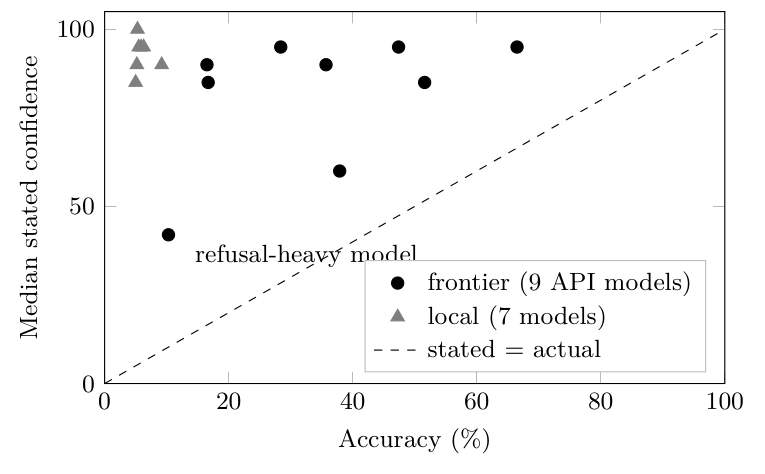 Consistent overconfidence across all sixteen evaluated models: per-model median stated confidence (means appear in Table [tab:vendor]) vs. actual accuracy for all 16 models on the same 1,500 blind SimpleQA items. All models lie above the calibration diagonal; the refusal-heavy model (median stated confidence 42 at 10.3% accuracy, CITL pp) carries the best self-AUROC, 0.788, yet remains overconfident; the smallest calibration gap belongs to the dispersed-confidence model ( pp). Frontier medians per model: 95/85/95/60/90/95/85/90/42 in the row order of Table [tab:vendor]; the seven-model local tier spans accuracy 5.0–9.2% at median confidence 85–100, CITL to pp (graded per local model 98–1,498 after parse-failure exclusion, with deepseek-r1:8b halted at 114 items by its pre-committed stopping rule; the local tier serves the manipulation probes and this picture, not discrimination claims).
Result 2: no confirmatory improvement in discrimination from measured-profile injection
A natural repair is to hand the model its own measured competence profile (per-domain accuracy from held-out data) at answer time. In a placebo-controlled ladder experiment (arms: no profile, placebo profile matched for overall level, own measured profile, shuffled profile), the own-profile arm did not significantly beat placebo on the confirmatory endpoint: AUROC , 95% CI , raw , Holm-adjusted , and no confirmatory endpoint passed: a null on one confirmatory rung, whose positive point estimate does not survive pre-registered correction. The design resolves moderate effects: a post hoc normal approximation with the CI-implied SE () reaches 80% power at AUROC for two-sided and at the Holm level , before the two-way robustness gate, both above the observed . The data are compatible with both a true null and a small true effect.
An earlier pre-registered six-arm design reported about AUROC over placebo in two other model families (Chernets, 2026a); the stricter single-vendor frontier ladder here did not confirm it, so the gain is family- and protocol-specific, not portable by default. Nor is the battery too flat to carry a profile signal. Taking each item’s own bin accuracy (computed leave-one-out, so an item never contributes to its own predictor) as the sole predictor of that item’s correctness yields an oracle AUROC of 0.758 for the confirmatory subject (0.716–0.789 across the four ladder subjects), with per-bin accuracy spread (population SD) 0.195 and range 0.15–1.00 over the 21 bins. Bins therefore differ enough for a truthful profile to carry substantial information. The oracle measures what bin membership says about correctness, not the gain an injected profile can realize; the null concerns that delivery channel (profileitem–bin associationconfidence update), not a battery too flat to register one.1 Exploratory patterns (larger gains where baseline calibration is weakest) are hypothesis-generating only.
Ladder design and placebo validation.
Four frozen rungs (subjects: Claude Haiku 4.5, Sonnet 5, Opus 4.8, and Fable 5; exact IDs claude-haiku-4-5-20251001, claude-sonnet-5, claude-opus-4-8, claude-fable-5), each with four blinded arms occupying the same calibration slot of an otherwise identical prompt: off (profile-shaped structural emptiness), placebo (calibration-irrelevant profile matched for overall level; validated per rung against the true profile at ; measured , , , ), core (the model’s own measured per-domain profile), and shuffled (bin-permuted false profile; exploratory after a failed manipulation check demoted it from confirmatory status). The 315-item battery spans 21 domain bins with trap items and an explicit abstention token; item–arm assignments were frozen before the confirmatory phase, with per-item randomized arm order and no arm names in subject-visible text. A pre-registered degeneracy bound (off accuracy ) demoted three of four rungs from all confirmatory computation; Table 3 reports the one eligible rung. The surviving rung’s off-arm accuracy is 0.847 against the 0.85 threshold, while the demoted rungs sit at 0.855, 0.888, and 0.900, with off-arm answered-only AUROCs of 0.575, 0.628, and 0.500 (descriptively, near-ceiling accuracy leaves little calibration signal to repair). Descriptively, core exceeds placebo in per-arm answered-only AUROC on all four rungs (Haiku , Sonnet , Opus , Fable ; Sonnet’s frozen paired contrast is the above), with no trend against off accuracy (exploratory slope , CI ); a 0.84 bound would leave no eligible rung, and 0.86 would add only the rung. All four subjects are drawn from a single vendor family; see Limitations.
| Arm | Acc. (all items) | AUROC | Brier | ECE | Paired AUROC (corearm) |
|---|---|---|---|---|---|
| off (no profile) | 0.847 | 0.564 | 0.138 | 0.110 | [] |
| placebo | 0.857 | 0.578 | 0.127 | 0.090 | [] |
| core (own profile) | 0.857 | 0.625 | 0.127 | 0.099 | — |
| shuffled (false) | 0.842 | 0.589 | 0.140 | 0.113 | not computed (exploratory) |
Profile-injection ladder, confirmatory-eligible rung (subject: Claude Sonnet 5; : 294 non-trap items 2 pre-registered fresh-process replicates, as the harness exposes neither temperature nor seed; AUROC answered-only). Confirmatory contrasts (item-clustered bootstrap): coreplacebo AUROC , 95% CI , raw ; coreoff , CI , raw ; both fail Holm correction () and the two-way itembatch gate (a pre-registered robustness requirement clustering by both item and collection batch). The paired- column repeats the frozen analysis’ item-clustered paired contrasts against core; they are not the arithmetic difference of the per-arm AUROC column, and no confirmatory paired contrast was computed for shuffled (demoted to exploratory before the confirmatory phase). core does not dominate on calibration either: its ECE (0.099) exceeds placebo’s (0.090), consistent with the confirmatory null. {#tab:ladder}
Result 3: the self-image channel is manipulable
If an evaluation harness consumes a self-competence profile, that slot is an input channel, and inputs can be forged. We distinguish three claims of decreasing evidential strength and state which one each result supports. (i) Causal manipulability, shown below in exploratory runs: substituting a false profile causally changes stated confidence and degrades calibration in controlled runs. (ii) Integrity vulnerability, conditional: it matters for harnesses that actually inject competence profiles from a source an adversary can influence. (iii) Practical attack surface in deployed evaluation pipelines, the hypothesis these results motivate for deployed-pipeline tests. Replacing the true profile with a shuffled (false) one drove an exploratory frontier rung’s self-assessment AUROC to chance level: 0.474 versus 0.710 with the true profile (ceiling-demoted exploratory rung; item-clustered bootstrap: 0.710 [0.586, 0.820] vs. 0.474 [0.349, 0.599], difference [, ]). For contrast, on the confirmatory-eligible rung shuffled sat between placebo and core (0.589 vs. 0.578 and 0.625; item-clustered paired contrast, exploratory: ). By construction that rung tests manipulation bluntly. The false profile twice failed the pre-registered check (external judge 0.99/0.94 vs. a bound), the frozen rule demoted the arm before confirmatory data existed, and a subject can discount a detectably implausible profile. The failed check is a finding in its own right: a frontier judge detects forgery from plausibility alone.
On a zero-cost local setup, a single fabricated claim (“95% accuracy in this domain”) raised a model’s stated confidence on the same item from 50 to 95 (glm4:9b, points, the largest shift in the probe). Two boundary conditions bound the effect: the model must be able to associate the current item with a profile bin (on unlabeled items small local models ignore the profile; deltas , consistent with the frozen null of Result 2), and ceiling-pinned models (confidence regardless) have nothing to attack.
With the topic-labeled pass below, this establishes claim (i) (per-model microprobe: Table 4).
Exploratory topic-labeled pass: both sides of the boundary, live.
The first boundary condition above (the model must be able to associate the item with a profile bin) is itself testable: labeling each probe with its topic, a disclosed deviation from the frozen protocol, removes the association obstacle. In a full local pass (five models, 16 held-out probes per arm, temperature 0, fixed seed), the false profile that was inert on unlabeled items is consumed by four of five models once items are labeled: Brier degrades by (glm4:9b), (llama3.2:3b, with accuracy falling 37.5%25.0%), (mistral:7b), and (phi4-mini); at the per-probe bootstrap CIs include zero for each model, so this pass measures direction and mechanism, and per-model effect sizes call for larger batteries;
the fifth (qwen3:8b) answers the battery at ceiling (100% accuracy, confidence 100 in both arms, ), reproducing the “nothing to attack” boundary. The mechanism is directional and symmetric: a false high claim inflates confidence exactly in the weakest bin (llama3.2 physics: stated confidence 0100 in a bin with 25% held-out accuracy; phi4-mini logic 1365), and a false low claim deflates confidence on correct answers (llama3.2 history 1000 at 75% held-out accuracy), up to inducing abstention on items the model otherwise answers.
| Model | Conf. @ “0%” | Conf. @ “95%” | |
|---|---|---|---|
| glm4:9b | 50 | 95 | |
| llama3.2:3b | 80 | 95 | |
| mistral:7b | 90 | 100 | |
| phi4-mini | 90 | 95 | |
| qwen3:8b | 100 | 100 |
Local microprobe (exploratory): stated confidence on the same (incorrectly answered) item when the injected profile slot claims “0% accuracy” vs. “95% accuracy” in the item’s domain; five local open-weights models, temperature 0. The ceiling-pinned model (bottom row) has no declarative calibration to attack. {#tab:microprobe}
Implications for evaluation practice
The implications rest on one task family (post-2023 open-form factual QA) and one elicitation format.
(1) Reverse the role of stated confidence. Self-reported confidence should be a measured target of evaluation, not an input to it under current elicitation. Supporting numbers: 60.1% of high-confidence answers from the nine API models are wrong (46.6% for one flagship per laboratory); on SimpleQA, post hoc, requiring blind agreement of two flagships lowers confident failures from 4.6% to 1.9% (gpt-5.6-sol) and from 10.3% to 2.8% (claude-fable-5), and in a 26 October 2026 snapshot on 100 fresh items, agreed answers of a current flagship pair are right 97.3–97.4% of the time (72/74, 76/78 agreed items out of 100); and the best self-AUROC (0.788) belongs to the lowest-accuracy model, partly through its refusal policy (0.660 without refusals).
(2) Audit self-certainty before it weights judge votes. Judge-style self-assessment is a separate task, but these findings motivate measuring self-certainty before any LLM-as-judge or ensemble scheme weights votes by it: on own answers it sits below AUROC 0.62 for six of nine models, while the saturated 85–95 band looks reassuring in logs. Weights should come from measured per-model calibration, not the report itself.
(3) Authenticate the profile slot. Per the three-level threat model of Section 6, this applies to harnesses that inject profiles from an influenceable source; for them, the repair channel is the exposure: the same injected profile that was supposed to fix calibration accepts forgeries that push discrimination to chance level (0.474) and degrade Brier scores end to end once items are associable. Such a harness needs an integrity gate: signed profiles, provenance checks, or at minimum separating who measures the profile from who supplies it at inference time. A signature establishes who supplied a profile and that it has not changed, not when it was measured; the time comes from registering the profile’s hash with a third party at measurement (Laurie et al., 2013), which also exposes a profile re-signed later under its original date. Whoever measures the profile should not earn revenue from what it says. Manipulability is shown (level i); for such a harness the slot is vulnerable to input manipulation whenever an adversary can influence its source (level ii); a deployed attack surface (level iii) is the next test. Payment infrastructure already reserves such a slot: Mastercard’s Verifiable Intent keeps an optional agent_attestation claim “reserved for future behavioral attestation schemes” (Mastercard, 2026); filled with a self-report, it would inherit the unauthenticated channel measured here.
(4) External measurement as a comparator, with its own audit. Blind-panel agreement outperforms self-assessment under this panel composition, where self-assessment fails worst (AUROC ), but panels have their own measured failure regimes, examined in the companion paper (Chernets, 2026b), and adopting the panel signal without that audit would repeat the same mistake one level up. An extension pre-registered as exploratory adds a third angle: across 12 directed profile-swap pairs (3,780 calls), substituting another model’s measured profile shifted AUROC by at most (and occasionally helped), while the similarity-rank prediction of transfer loss failed (Spearman ): in this exploratory swap set, no transfer penalty exceeded 0.04 AUROC. A research-prototype diagnostic battery is described in the appendix.
Limitations
The headline rests on one benchmark family (post-2023 open-form factual QA), and each provider is represented by one model (budget/mid-tier for eight of nine), so claims are per model. Stated-confidence elicitation uses one prompt format for the headline numbers. An exploratory two-stage arm (150 items five local models) suggests format is not the culprit: a stateless post-hoc confidence query lowered stated confidence and confident-error rates but not discrimination (self-AUROC 0.43–0.61 in both formats; pooled paired-bootstrap AUROC on pairs, deterministic no-LLM labels on 142–150 rows per model, a labeled deviation from the string-only grader, under which 90% of cases are unresolvable).
The injection null is one confirmatory rung of one ladder (315 items, 21 bins), with all four subjects from a single vendor family. The manipulation evidence combines one exploratory frontier rung, a local microprobe, and a topic-labeled local pass (a disclosed deviation) and is exploratory by design. Grading is partially LLM-based and its human validation is a 50-item spot-check (98% agreement, one conservative error); a seed-fixed 300-item audit of judge-resolved frontier verdicts by a model family outside the grader’s agreed 288/300 (96%), all twelve disagreements lenient (Chernets, 2026a), the direction that understates overconfidence. The grader’s vendor family also fields one CN-panel member, so grader independence is itself measured: a second grader from a family outside all panels and the grader’s own regraded all 342 consensus verdicts in the hardest difficulty quintile (see companion paper) and agreed 342/342. The grader is itself a local-tier subject, and a cross-family regrade of all 1,441 self-graded rows agreed 98.3%, disagreement running toward self-leniency (24 down-flips vs. 1 up; accuracy 5.94.4%), which strengthens the overconfidence picture. A rule-based re-grade of all 22,248 rows, stratified by model with no LLM in the loop, resolves 95.9% and changes 2.65% of those verdicts, mostly correctwrong: accuracy falls for all sixteen models, so every CITL grows, and API-tier self-AUROC moves by at most (range 0.539–0.787 after re-grading; five of nine stay below 0.62, the sixth moving from 0.598 to 0.625). Neither the overconfidence nor the discrimination finding depends on the LLM grader. Panel-vs-self comparisons share raw data with the companion paper; no table is duplicated between the two (boundary in Section 2).
Conclusion
Self-assessment, as currently elicited, fails three tests an evaluation signal must pass: it tracks correctness too weakly to gate decisions yet stays severely overconfident, profile injection produced no demonstrable gain in discrimination under placebo control, and its input channel accepts forgeries. Until models earn calibration on measured evidence, stated confidence is a phenomenon to study, not a signal to consume.
Competing interests.
The author is a named applicant on pending patent applications, not granted patents, covering AI orchestration and multi-model validation systems of the kind this paper examines.
Code (reference implementation).
An open-source reference implementation of cross-lab verification on a smartphone (ChatGPT and Claude side by side; no server, no API key): https://github.com/vadimchernets/poly-duo https://polyhelper.ai/duo/. Its modes are not evaluated in this paper; the two-flagship figures are a re-analysis of the companion collection, not measurements of the app.
References
A. Azaria and T. Mitchell. The internal state of an LLM knows when it’s lying. In Findings of EMNLP, 2023. arXiv:2304.13734.
J.-P. Cacioli. Verbal confidence saturation in 3–9B open-weight instruction-tuned LLMs: A pre-registered psychometric validity screen. arXiv preprint arXiv:2604.22215, 2026.
V. Chernets. Architectural trust: Why consumer trust in agentic commerce migrates from AI models to verifiable architecture. SSRN working paper 7191261, 2026. https://doi.org/10.2139/ssrn.7191261.
V. Chernets. Verification theater: Measured failure modes of AI verifier panels. NeurIPS 2026 Workshop Who Verifies the Agents? Toward Reliable Agent Development, 2026. https://doi.org/10.5281/zenodo.23197641 (cited for panel-side regimes only).
K. Ding. When LLMs agree, are they right? Auditing self-consistency and cross-model agreement as confidence signals. arXiv preprint arXiv:2607.08065, 2026.
S. Farquhar, J. Kossen, L. Kuhn, and Y. Gal. Detecting hallucinations in large language models using semantic entropy. Nature, 630(8017):625–630, 2024.
K. Greshake, S. Abdelnabi, S. Mishra, C. Endres, T. Holz, and M. Fritz. Not what you’ve signed up for: Compromising real-world LLM-integrated applications with indirect prompt injection. In Proceedings of the 16th ACM Workshop on Artificial Intelligence and Security (AISec), 2023. arXiv:2302.12173.
C. Guo, G. Pleiss, Y. Sun, and K. Q. Weinberger. On calibration of modern neural networks. In ICML, 2017. arXiv:1706.04599.
Z. Jiang, J. Araki, H. Ding, and G. Neubig. How can we know when language models know? On the calibration of language models for question answering. Transactions of the Association for Computational Linguistics, 9:962–977, 2021. arXiv:2012.00955.
S. Kadavath, T. Conerly, A. Askell, et al. Language models (mostly) know what they know. arXiv:2207.05221, 2022.
S. Lin, J. Hilton, and O. Evans. TruthfulQA: Measuring how models mimic human falsehoods. In ACL, 2022. arXiv:2109.07958.
S. Lin, J. Hilton, and O. Evans. Teaching models to express their uncertainty in words. Transactions on Machine Learning Research, 2022. arXiv:2205.14334.
B. Laurie, A. Langley, and E. Kasper. Certificate transparency. RFC 6962, Internet Engineering Task Force, 2013. doi:10.17487/RFC6962.
Mastercard. Verifiable Intent: Open specification for cryptographic agent authorization in commerce (draft v0.1). Specification repository, 2026. https://github.com/agent-intent/verifiable-intent.
L. Meyer, S. Rossi, W. Chen, T. Laurent, and Y. Li. An analysis of training-free self-reported confidence in language models. arXiv preprint arXiv:2609.20541, 2026.
I. D. Raji, P. Xu, C. Honigsberg, and D. Ho. Outsider oversight: Designing a third party audit ecosystem for AI governance. In AIES, pages 557–571, 2022.
K. Tian, E. Mitchell, A. Zhou, A. Sharma, R. Rafailov, H. Yao, C. Finn, and C. D. Manning. Just ask for calibration: Strategies for eliciting calibrated confidence scores from language models fine-tuned with human feedback. In EMNLP, 2023. arXiv:2305.14975.
P. Verga, S. Hofstätter, S. Althammer, Y. Su, A. Piktus, A. Arkhangorodsky, M. Xu, N. White, and P. Lewis. Replacing judges with juries: Evaluating LLM generations with a panel of diverse models. arXiv:2404.18796, 2024.
J. Wei, K. Nguyen, H. W. Chung, Y. J. Jiao, S. Papay, A. Glaese, J. Schulman, and W. Fedus. Measuring short-form factuality in large language models. arXiv:2411.04368, 2024.
M. Xiong, Z. Hu, X. Lu, Y. Li, J. Fu, J. He, and B. Hooi. Can LLMs express their uncertainty? An empirical evaluation of confidence elicitation in LLMs. In ICLR, 2024. arXiv:2306.13063.
Z. Yin, Q. Sun, Q. Guo, J. Wu, X. Qiu, and X. Huang. Do large language models know what they don’t know? In Findings of ACL, 2023. arXiv:2305.18153.
L. Zheng, W.-L. Chiang, Y. Sheng, et al. Judging LLM-as-a-judge with MT-Bench and Chatbot Arena. In NeurIPS Datasets and Benchmarks, 2023. arXiv:2306.05685.
Research prototype: a self-assessment diagnostic
A byproduct of this study is a compact self-assessment diagnostic: a fixed battery of short, deterministically gradable probes spanning the study’s domain bins (numerical, logic, physics, history, code, probability, and others), plus trap items with an explicit abstention token. Each answer carries a stated 0–100 confidence, and the tool scores a composite of Brier score, overconfidence gap (mean confidence minus accuracy), confidence discrimination (mean confidence on correct minus incorrect answers), and trap-abstention rate, mapping the result to tiers from well-calibrated to confidently blind. It operationalizes this paper’s thesis that calibration is something to measure about a model, not to read off its self-reports, and is released with the replication package as a research prototype. It uses paraphrased probes instead of the frozen battery, and its discrimination score is a proxy for the ladder’s AUROC endpoint.
Reproducibility appendix
All headline numbers here are deterministic functions of the released raw JSONL, and no step involves unseeded randomness, network access, GPU computation, or re-querying any model.
Data availability.
The frozen pre-registration (public OSF registration): https://osf.io/4y9dv; replication package and analysis scripts: https://osf.io/jtvu9/. The oracle-ceiling script oracle_auroc.py is deposited with this paper at https://doi.org/10.5281/zenodo.23197651.
Elicitation prompt (verbatim).
System: You answer short factual questions. Respond with ONLY a JSON object like {"answer": "<short answer>", "confidence": 85}. confidence is an integer 0-100 for how sure you are the answer is correct. No other text. The user turn contains the bare question, and refusals are detected from the answer field by the frozen refusal lexicon in the grading script.
Model identifiers and run dates.
One API model per provider (budget/mid-tier except Moonshot, whose kimi-k3, released 16 July 2026, is its flagship), smoke-verified live on 2026-07-24 and collected in late July 2026 (per-call timestamps in the run manifest, released with the replication package): anthropic claude-haiku-4-5-20251001; openai gpt-5-mini; google gemini-3.6-flash; xai grok-4-fast; deepseek deepseek-chat; alibaba qwen-plus; moonshot kimi-k3 (a disclosed collection deviation: 670 of 1,500 items on the first-party account, the remainder via an aggregator route served by the same first-party infrastructure with reasoning disabled, served_by recorded per call; a first-party-only sensitivity split was pre-committed); zhipu glm-4.5; mistral mistral-small-latest. Local tier (Ollama, temperature 0): gemma4:e4b, llama3.2:3b, phi4-mini, qwen3:8b, deepseek-r1:8b, glm4:9b, mistral:7b.
The companion paper (Chernets, 2026b) shares the same frozen registration and raw collection. The replication package contains: the frozen registration text and protocol, the run manifest with exact model identifiers, the raw graded collections (frontier and local tiers, plus the exploratory benchmark-age comparison arm), and three dependency-free CPU scripts. The first (compute_panel_vs_own_auroc.py, folder replication-package-v2/cf-moat) is the canonical definition of the panel-agreement vs. own-confidence AUROC comparison (Section 4) and prints, alongside the canonical values, every non-canonical alternative reading (binary panel signal, indeterminate coding, tie handling, pooling variants) so the choice of reading is auditable. The second and third sit in folder self-confidence-analysis, whose README maps each script to the numbers it prints. The second (analysis_tae_week1.py) re-prints Table 1, the Figure [fig:overconf] coordinates, the benchmark-age gaps of Section 3, and performs a read-only check of the frozen ladder values reported in Table 3 against the ladder’s frozen analysis file. The third (analysis_tae_decomposition.py) re-prints the pooled-AUROC decomposition and rank-normalization of Section 4, the label-free recoding of the panel signal, the per-model high-confidence error rates, the CITL/Brier/ECE columns of Table 1, the risk–coverage values of Table 2, and the demoted-rung descriptives of Section 5. Each script runs in seconds on a laptop CPU with the Python standard library only. The profile-injection ladder ships as its own frozen bundle (protocol, battery, per-arm scored rows, and analysis JSON), self-calibration-archive.zip in the same component.
Computed from the frozen per-item arm scores (
scored-arms-*.jsonl; non-trap, statusok; for the confirmatory subject) byoracle_auroc.py, released with this paper; all arms and replicates of an item are left out together. Used directly as a predictor, the held-out core profile values as rendered in the slot reach AUROC 0.820 on the confirmatory subject’s answered core-arm rows (; 0.732–0.820 across the four subjects), against 0.625 for the stated confidence on the same rows (tae_core_profile_auroc.py).↩︎
How to cite
Chernets, V. (2026). Weakly Discriminative, Not Repaired by Profile Injection, and Manipulable: Self-Confidence in LLM Evaluation [Paper presentation]. NeurIPS 2026 Workshop: TAE. Zenodo. https://doi.org/10.5281/zenodo.23197651
@misc{chernets2026selfconfidenceevaluation,
  author       = {Chernets, Vadym},
  title        = {{Weakly Discriminative, Not Repaired by Profile Injection, and Manipulable: Self-Confidence in LLM Evaluation}},
  year         = {2026},
  howpublished = {Zenodo; NeurIPS 2026 Workshop: TAE},
  doi          = {10.5281/zenodo.23197651},
  url          = {https://doi.org/10.5281/zenodo.23197651}
}