Verification Theater: Measured Failure Modes of AI Verifier Panels
Vadym Chernets, Independent Researcher · ORCID 0009-0007-4845-3163
Zenodo DOI 10.5281/zenodo.23197641 · GitHub
Accepted (poster) at NeurIPS 2026 Workshop “Who Verifies the Agents? Toward Reliable Agent Development” · NeurIPS page · OpenReview · OpenReview profile
Accepted as a poster at the NeurIPS 2026 workshop "Who Verifies the Agents? Toward Reliable Agent Development" (non-archival). Archived copy: 10.5281/zenodo.23197641. PDF: verification-theater.pdf. Figures and tables below are converted from the LaTeX source; the PDF is authoritative.
Abstract
Multi-agent verification is becoming a default trust mechanism: an answer is trusted because independent models agree on it. Using a pre-registered, blind collection in which sixteen models (nine API, mostly mid-tier; seven local) answered the same 1,500 SimpleQA questions, plus a 750-question TruthfulQA multiple-choice arm and an exploratory dialogue arm, we measure when panel verification stops working while continuing to look like it works—verification theater. We report three measured failure regimes and one exploratory one. First, a difficulty inversion: under population difficulty (ranked by all sixteen models) the certification lift of agreement is 2.7–4.6 on the three easiest quintiles, 0.82 on the second-hardest, and zero on the hardest: 0 of 342 replicated answers correct (106 unique questions; 13 expected at the stratum’s base rate). Under leave-panel-out difficulty (the 13 non-panel models), the pooled inversion disappears (78/354 correct, lift 2.36), while the zero persists for the cross-bloc panel (0/116). Here, agreement fails as certification on what the deployed population finds hard, and for the cross-bloc panel under panel-independent difficulty too. These panels are mid-tier: in a post hoc re-analysis of a companion flagship collection (5 August 2026 snapshot), a gpt-5.6-sol + claude-fable-5 pair agreed on 37 of the 106 zero-stratum questions and 34 of its agreed answers were correct, so the zero is measured for mid-tier panels only (with a benchmark-exposure caveat). Second, under multiple choice (local tier), panels unanimously and confidently certified a wrong answer on 4.0–7.2% of questions, versus 1.5–4.6% on the same tier’s open-form and 0.3–4.9% for the API-tier open-form; as the formats come from different benchmarks, a same-question swap would be the direct test of format. Third, independence labels fail: geopolitical bloc showed no detectable effect on error correlation ( 0.2854 intra- vs. 0.2736 cross-bloc; ), and in the pairs measured neither did lineage: the same-base distilled pair ranked 14th of 15 US/CN local pairs (ordered from most to least correlated; ). Fourth, in an exploratory conformity arm, verifiers that had disagreed blind endorsed the answer in 38.5% of cases once shown it as a colleague’s; a reverse-prompt control on local models shows these flips track the presence of a proposed answer, not its truth (38.9% toward wrong vs. 34.7% toward correct; McNemar ). We derive a measurement discipline that separates verification from theater.
Introduction: the theater problem
Panels of AI models checking each other are shipping as trust infrastructure, and agreement between them is increasingly priced as evidence. Agent payment protocols already state the gap they leave: Mastercard’s Verifiable Intent “verifies that an agent operated within its constraints. It does not verify how the agent behaved” (Mastercard, 2026). That check is left to whoever verifies the agent’s outputs, increasingly a panel of models. Security research has long had a name for mechanisms that produce the aesthetics of protection without its substance (Schneier, 2003); we ask, with measurements rather than metaphor, when panel verification earns that name. The core finding is an inversion: the certification value of agreement is concentrated on easy questions and vanishes—or reverses—exactly where verification matters most. We treat this not as a single anomaly but as one of four distinct regimes in which a verifier panel keeps the appearance of checking while losing its substance, and we derive a common remedy. We use “theater” for what is observed; which mechanism produces it is an open question (Section 10).
Concretely, this paper contributes the following. (C1) A difficulty-stratified measurement of certification lift. The value of independent agreement concentrates on easy questions. Under population difficulty it inverts on the hardest quintile (0 of 342 replicated answers correct, spanning 106 unique questions). Under leave-panel-out difficulty the pooled inversion disappears and the zero persists only for the cross-bloc panel (0/116). Both codings are reported together throughout. (C2) Evidence that multiple-choice answer spaces are associated with higher unanimous confident certified error (4.0–7.2%) than open-form answers (1.5–4.6% local, 0.3–4.9% frontier), measured on one benchmark per format (Section 5). (C3) Two pre-registered null results: geopolitical bloc has no detectable effect on error correlation, and lineage did not predict it in the pairs measured. Independence should therefore be measured per pair as a -matrix rather than assumed from brand or family tree. (C4, exploratory) A conformity measurement with a reverse-prompt control, run on local models, showing that dialogue-mode verifiers track the presence of a proposed answer rather than its truth. (C5) From these, a measurement discipline—published per-task-class -matrices, difficulty-stratified certification claims, blind-first elicitation, hard-regime escalation, and checks recorded with their source and blindness—that operationally separates verification from its theater.
What is measured here and what is in the companion paper.
The same blind collection grounds a companion paper (Chernets, 2026a). Reported only in this paper: the difficulty-stratified lift ladder under both difficulty codings, its robustness suite, the -matrix, and the per-model, confidence-gate, and correct-blind-abandonment decompositions of the conformity arm. Summarized here from the companion, not re-derived: the trust construct and the full statement of the blind collection protocol. Overlapping: the companion reports the pooled certification ratios and brief summaries of the analyses detailed here, including a prose summary of the reverse-prompt control; each overlap is cross-flagged where it occurs. All results in C1–C4 are measured and reported in full here.
Scope.
The panels use one model per frontier vendor (mid-tier except Moonshot’s flagship kimi-k3; a post hoc flagship-pair re-analysis is in Section 4), SimpleQA for open-form and TruthfulQA for multiple-choice questions, and local models for the conformity control. What we expect to carry over to other panels and benchmarks is the measurement pattern: stratify by difficulty, measure , elicit blind.
Prior art and framing
Byzantine fault-tolerant consensus tolerates arbitrary, even adversarially coordinated, behavior by up to of replicas (Lamport et al., 1982; Castro and Liskov, 1999); what it assumes is that failures occur independently, so that more than rarely fail together—for which Castro and Liskov (1999) prescribe different implementations, operating systems, and administrators per replica. For AI verifier panels that independence is the assumption we test and find unearned: correlated errors spend the fault budget together, and the budget cannot be checked without measuring the correlation. The consensus-paradox literature already names agreement-stabilized error in homogeneous swarms (Shehata and Li, 2026). zkML verifies that a computation ran; whether its answer is true is the question studied here, so the two are complementary. The Verifier’s Dilemma (Luu et al., 2015) supplies the incentive analysis; Raji et al. (2022) supply the auditor-selection problem; Du et al. (2024), Farquhar et al. (2024), and Ding (2026) supply the agreement-signal literature this paper stress-tests. The trust construct itself was introduced in a companion paper (Chernets, 2026a); this paper maps where the construct’s verification engine fails while appearing to run. Test-time-compute work reaches the complementary conclusion from the constructive side: ensembles of diverse aspect verifiers outperform any single verifier (Lifshitz et al., 2025), a panel of small judges drawn from disjoint families outperforms a single large judge at a fraction of the cost (Verga et al., 2024), and a systematic re-evaluation of multi-agent debate identifies model heterogeneity as the one reliable improver (Zhang et al., 2025); the debate line shows structured adversarial argument helping weaker judges reach truer answers (Khan et al., 2024). Peer-reviewed evidence already documents substantial cross-provider error correlation—largest precisely among the most accurate models, even across distinct architectures and providers (Kim et al., 2025); nine LLM judges carry about two effective votes (Kohli, 2026)—which independently motivates measuring dependence rather than inferring it from labels. That literature selects panels for diversity; this paper measures what the selected-for property is worth—and what its absence silently costs—in verification.
Data and measurement
One pre-registered, blind collection (each model answered every question in isolation, never seeing another model’s answer; protocol frozen publicly before confirmatory data collection; public registration at https://osf.io/4y9dv): sixteen models (identifiers in Appendix A) a pre-registered random subsample of 1,500 of SimpleQA’s 4,326 items (fixed seed, drawn before any collection; subsample CSV with its SHA-256 attached to the frozen registration) at temperature zero with stated 0–100 confidence (13,446 clean frontier answers; 8,802 local-tier answers); a 750-item TruthfulQA MC1 arm on the local tier, derived from a frozen copy of the official repository file (790 items, byte-identical to the canonical CSV) by a pre-registered constructor requiring at least two distinct incorrect options per item (fixed shuffle seed; 695 items fully answered by all seven models); an exploratory active-vs-blind dialogue arm. SimpleQA is adversarially collected against a frontier model, with a single indisputable answer per question (Wei et al., 2024): the hard stratum therefore probes genuine parametric-knowledge boundaries, and grading reduces to equivalence-to-gold. TruthfulQA supplies the constrained-answer-space arm (Lin et al., 2022). Panels are analytic combinations of the single blind collection; all re-analysis is deterministic (string-equivalence coding with refusals and zero-overlap counted as non-agreement; indeterminate pairs reported as brackets). Difficulty is operationalized observationally as mean 16-model accuracy per question, split into rank quintiles of 300 questions. The same raw collection grounds the companion paper (Chernets, 2026a); the partition between the two papers is stated in Section 1.
Open-form grading is two-stage: a deterministic string-equivalence pass (26.8% of frontier grades) plus refusal detection (6.6%), with the remaining 66.5% graded by an LLM grader; a human spot-check agreed with the grader on 98% of a random sample (). Because two-thirds of grades are model-produced, all headline results are accompanied by a grader-error sensitivity resampling (10% of model-graded verdicts flipped, 200 seeded resamples; Section 4 and Appendix A). The headlines hold under grader noise of that size.
Failure regime I: the difficulty inversion
Two difficulty codings. Population difficulty ranks questions by the accuracy of all sixteen models; it is the default below. Leave-panel-out difficulty ranks them by the 13 models outside the panel. The leave-panel-out paragraph below reports where the two codings diverge.
The three pre-specified frontier panels are analytic 3-model combinations of the single blind collection: US-bloc (Anthropic, OpenAI, Google), CN-bloc (DeepSeek, Alibaba, Moonshot), and cross-bloc (Anthropic, DeepSeek, Mistral). An answer counts as replicated when at least one of the primary’s two panel-mates independently produced an equivalent answer under the frozen deterministic coding of Section 3. Lift is .
Pooled across the three panels, the probability that a replicated answer is correct rises from 0.0% (0/342 answers on 106 unique questions; Wilson upper bound 1.1% per answer, 3.5% per question, App. A.2) on the hardest quintile through 12.8%, 57.5%, and 81.0% to 95.1% on the easiest (Figure 1; intervals in Table 1). The corresponding lift over non-replicated answers runs 0.00 / 0.82 / 2.68 / 3.09 / 4.56. On the hardest 20% of questions every observed agreement certified a wrong answer. On the next quintile the point estimate puts agreement below parity with disagreement (0.82, CI [0.51, 1.21]). The hardest-quintile zero replicates in each panel separately (Q1/Q5 lifts: US 0.00/4.25, CN 0.00/9.76, cross-bloc 0.00/4.04); the Q2 sub-parity holds in the CN and cross-bloc panels, while the US panel’s Q2 lift is 1.20. Much of the pooled certification lift is carried by easy questions, so an unstratified lift claim overstates what verification delivers where it is needed. The Q1 zero is measured against a live base rate: non-replicated Q1 answers are correct 3.9% of the time (89/2286), so a baseline in which replication carries no information about correctness (lift ) predicts correct replicated answers—the observed 0 (upper bound 1.1%) sits significantly below the stratum’s own base rate. This baseline is conservative here: a null preserving the full measured inter-model correlation structure—one common permutation of correctness labels across the stratum’s questions, replication structure frozen (2,000 permutations)—expects 11.7–12.4 correct replicated answers and never produced the observed 0 (; minimum 3); folding the measured pairwise into an analytic bivariate null raises the expectation further, because positively correlated errors imply positively correlated correct answers. What populates the stratum is itself informative. The 342 cells span 106 unique questions (cluster-level bound in Appendix A.2). They are ordinary narrow, plainly worded factoids (median 17 words), and models rarely abstain on them (0.5 of 9 answers per question). Their wrong answers cluster: on 70.8% of these questions at least three of the nine frontier models produced the same wrong answer, and on 67.4% of the questions replicated by more than one panel, the independently composed panels certified the identical wrong consensus—typically a famous-neighbor answer displacing the correct but less prominent entity. A manual subject-matter adjudication of all 106 gold labels found 2 disputable and 0 outright wrong; crediting the three questions with a defensible panel answer (one clearly, two partially), which together account for 13 of the 342 replicated answers, moves the hardest-quintile count from 0/342 to at most 13/342 (3.8%, lift ): even then agreement adds nothing over the stratum’s base rate, so the inversion holds while softening from a literal zero (one flagged label: a 2010 Royal Academy election scored against an honours title the academy does not confer).
The claim is directly testable: it predicts Q1 lift in any replication stratified by the deployed population’s own accuracy (under panel-independent stratification the prediction is the cross-bloc zero, not the pooled lift). Nor is the zero a grader artifact: an independent second grader from a vendor family outside every panel and the original grader (temperature zero, the identical frozen equivalence-to-gold prompt) regraded all 342 Q1 replicated verdicts and agreed on 342/342 (flips to correct 0/342, upper bound 1.1%); synthetic flipping of 10% of model-graded labels likewise leaves the certified-error share at or above 86.5% in every resample (appendix).
Leave-panel-out re-stratification.
Because panel members contribute to the population difficulty index, the hardest quintile is partly conditioned on the panel’s own failure. Re-stratifying by the 13 non-panel models only, replicated answers on the hardest quintile are correct in 78/354 cases (22.0%, pooled lift 2.36, above the 33/354 expected at lift 1), and the zero persists only for the cross-bloc panel (0/116; 0/88 on the stratum where all 13 non-panel models fail). The surviving zero is itself characterized: the stratum’s base rate is 31/778 = 3.98% (Wilson 2.8–5.6%), giving a lift-1 expectation of 4.6 correct among the 116; a correlation-preserving permutation null (2,000 permutations) yields , 95% range , and —significantly below the null, though not unreachable under it.
The pooled inversion is therefore a claim about where verification fails relative to what the deployed population finds hard, not relative to panel-independent difficulty. For practitioners the claim fits in one sentence: agreement does not certify answers on the questions the deployed population finds hard, and for the cross-bloc panel this held under panel-independent difficulty too.
Flagship re-analysis (post hoc).
The companion paper (Chernets, 2026a) reports a second blind collection on the same 1,500-question subsample with one flagship model per laboratory as of 5 August 2026, graded by a deterministic equivalence engine. Re-analysing its released responses for the two-model pair gpt-5.6-sol + claude-fable-5 (blind answers, agreement = deterministic equivalence), the pair agreed on 37 of the 106 questions that carry the hardest-quintile zero, and 34 of the 37 agreed answers were correct (91.9%, Wilson 78.7–97.2%; 19 of the claude-fable-5 arm’s answers were served by other Claude models, two of them among these 106 and neither agreed, so excluding them leaves 34 of 37 unchanged), against 0/342 for the mid-tier panels and 0/13 for the mid-tier pair from the same two vendors (gpt-5-mini + claude-haiku-4-5) under the same engine. The zero is therefore not observed at this flagship tier. Two facts bound the reading: gpt-5.6-sol answers 100 of the 105 resolved questions among these 106 correctly and reproduces the gold string verbatim on 64.2% of them, a benchmark-exposure signature, so difficulty indexed on the July models does not transfer to it; and the comparison spans two collection dates and reasoning settings. We read the inversion as tier-relative: it is measured for mid-tier panels, and whether it reappears for flagships on questions they cannot have seen is open (on a 100-item two-hop set composed after the study window, 29 of the pair’s 32 agreed answers were correct). A post hoc October snapshot (26 October 2026; same prompt, parser and engine, no tools) repeats the check for the current pairs gpt-6.1-sol + claude-opus-5-5 and gpt-6.1-sol + claude-fable-5-1: on all 106 questions (five gpt-6.1-sol answers collected on 27 October), the pairs agreed on 36 and 35, and 31 of the 35 and 31 of the 34 resolved agreed answers were correct (88.6% and 91.2%; the 5 August 2026 pair on the same 106: 34/37, 91.9%). These are accuracies of agreed answers (–35), not of either model. On these 106 questions gpt-5.6-sol also ran at medium effort in August; the effort difference applies only to the fresh set. The benchmark-exposure caveat applies as for August: gpt-6.1-sol alone is correct on 98/104 (94.2%), above both pairs, so agreement adds no accuracy here, and the mid-tier zero (0/342) does not appear for the October flagship pair either.
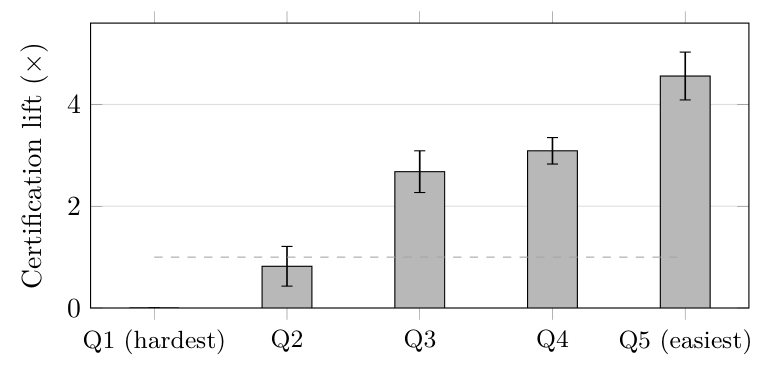 Certification lift by difficulty quintile, pooled over three frontier panels, with question-level bootstrap 95% intervals (2,000 seeded resamples; Appendix A.1). The dashed line marks lift , parity with non-replicated answers: the two hardest quintiles sit at or below it by point estimate (Q1 —a measured zero, not missing data; Q2 , its CI crossing parity), the three easiest well above it.
As a second sensitivity check, we re-derived the ladder under a fully label-free replication coding (deterministic string comparison of blind answers only, never consulting the correctness label): the Q1 result is essentially unchanged (2/344 replicated answers correct, 0.6% [0.2–2.1]; lift 0.15) and the below-1 lifts on the two hardest quintiles persist, while the top-quintile lift attenuates (4.56 to 2.33) because pure string matching misses surface variants of the same correct answer; multiple-choice results are unaffected, as agreement there is coded by answer letter and is label-free by construction.
Three robustness checks support the inversion. (i) Question-level bootstrap (2,000 seeded resamples within quintile) gives 95% CIs for the five lifts of [0.00, 0.00], [0.51, 1.21], [2.32, 3.09], [2.84, 3.35], and [4.16, 5.03]: the hard-regime intervals exclude the easy-regime ones entirely. (ii) Grader-error sensitivity: flipping 10% of the model-graded verdicts (200 seeded resamples; 97.1% of the 342 hardest-quintile replicated answers are model-graded and thus flippable) leaves the certified-error share of the hardest quintile at or above 86.5% in every resample, keeps the Q1 lift below 1 in 92% of resamples (median 0.82), and never brings the Q1–Q2 lifts near the Q3–Q5 lifts, which stay above 2 in all 200 resamples. (iii) The seven-model local tier replicates the hard–easy contrast with separate models and panels, non-monotonically (Q3 ): lifts 0.00 / 0.94 / 0.00 / 1.89 / 4.37 across the same quintiles, with 0 of 166 replicated answers correct on the hardest quintile; this tier is 94.8% LLM-graded and covered by the same grader-sensitivity resampling.
Failure regime II: constrained answer spaces
On multiple choice, four pre-specified local-tier panels (App. A) unanimously converged on a wrong option on 4.0–7.9% of the 695 fully-answered questions (per-panel: 4.0, 5.9, 6.6, 7.9). Open-form on the frontier tier, the deterministic bracket for confident unanimous wrong answers is 0.3–4.9%. Recomputing the same metric on the local tier’s own open-form answers (8,802 graded SimpleQA responses) removes the tier confound: the same local panels certify unanimous confident errors on only 1.5–4.6% of open-form items under strict deterministic coding (up to 9.8% including the indeterminate bracket), in line with the frontier open-form range. The gap therefore persists with model tier held fixed. The multiple-choice arm draws on TruthfulQA MC1 and the open-form arms on SimpleQA, so a same-question format swap would be the direct test of format against content.1 Per-panel bootstrap puts intervals on the gap where it is powered: MC minus open-form certified-consensus-error is pp [2.9, 6.8] (pilot), pp [3.9, 8.1] (US-local), and pp [2.6, 6.3] (cross-bloc), each excluding zero; the CN-local panel, whose open-form cell rests on the footnote’s 87-item set, does not resolve it.
One reading is that a menu converts scattered errors into shared ones: when the answer space is small, lookalike models land on the same distractor and the panel’s unanimity amplifies the error. The rates are not explainable by independent errors: with each member independently wrong at its marginal rate and errors spread over the wrong options (), the expected unanimous-same-wrong-option rate is 0.49–0.92% across the four panels, so the observed 4.0–7.9% is a 4.9–13.5 excess. Given the correlated errors of Section 6, the sharper comparison is with the same panels’ open-form rate above, and it points the same way.
Design consequence, as a testable prediction: an interface that hands agents a fixed option set should expect materially higher certified-consensus-error than open-form elicitation on the same content.
Requiring stated confidence from all three panelists barely dents the effect: the certified-consensus-error range moves from 4.0–7.9% to 4.0–7.2% (per-panel 4.0, 5.2, 6.0, 7.2), i.e. almost all unanimous wrong answers are also confident ones. The failure is also not confined to a topical niche: across the ten TruthfulQA categories with at least 20 items, pooled certified-consensus-error spans 1.0% (Conspiracies) to 8.6% (Economics), with Law, Health, and Sociology in between (Appendix A).
Failure regime III: independence labels do not predict independence
Across 36 frontier vendor pairs (1,448 shared questions), pairwise error correlation spans 0.123–0.395. The span is not organized by the labels people reach for. The most and least correlated pairs are both intra-bloc (googlexai 0.395 vs. googleopenai 0.123), and mean intra- vs. cross-bloc differ by only (0.2854 vs. 0.2736). On the 695 fully-answered multiple-choice items, the same-base lineage pair ranks 14th of the 15 pairs formed by the six US/CN-bloc local models (). The seventh local model is EU-bloc and outside the pre-registered bloc/lineage design; including it yields 21 pairs, of which the lineage pair ranks 20th. Both pre-registered nulls (bloc, lineage) survive re-analysis. The lineage test turns mainly on this one same-base pair, and within the pairs measured lineage did not predict error correlation. What remains predictive is measured correlation itself. The practical rule: independence is a per-pair, per-task-class quantity to be measured (a -matrix), not inferred from brand, flag, or family tree—assembling a panel by labels is casting, not verification. Pairwise measures empirical error dependence, not full statistical independence: low does not exclude higher-order dependence in panels of three or more, a further reason to treat independence as measured and task-conditioned, not assumed.
An exact permutation test over all 630 assignments of the bloc labels to the nine vendors finds no evidence of a bloc effect: the observed intra-minus-cross difference of is exceeded or matched by 132 of 630 relabelings (one-sided ; clustered-bootstrap 95% CI for the difference ). The test bounds the claim—small bloc effects are not excluded—and the operational conclusion stands: the label carries no signal usable in place of per-pair measurement. Because is bounded above when the pair’s base error rates differ, we re-ran the analysis on the marginal-normalized ratio : both pre-registered nulls survive (bloc difference , permutation ; the lineage pair stays 14th of 15), the spread persists (0.278–0.821 across frontier pairs), and the extremes relocate to two cross-bloc pairs (anthropicmoonshot 0.821, mistralopenai 0.278)—under either metric, no label organizes the spread.
Extending the matrix to all sixteen models: on the 81 questions answered by every model, pairwise spans to (120 pairs; block means: frontier–frontier 0.320, local–local 0.350, frontier–local 0.210)—a broad spread that no label taxonomy in our data predicts (Figure [fig:phi-matrix]). With 81 common items, individual cell estimates carry wide intervals; the result is the spread itself, not any single cell.
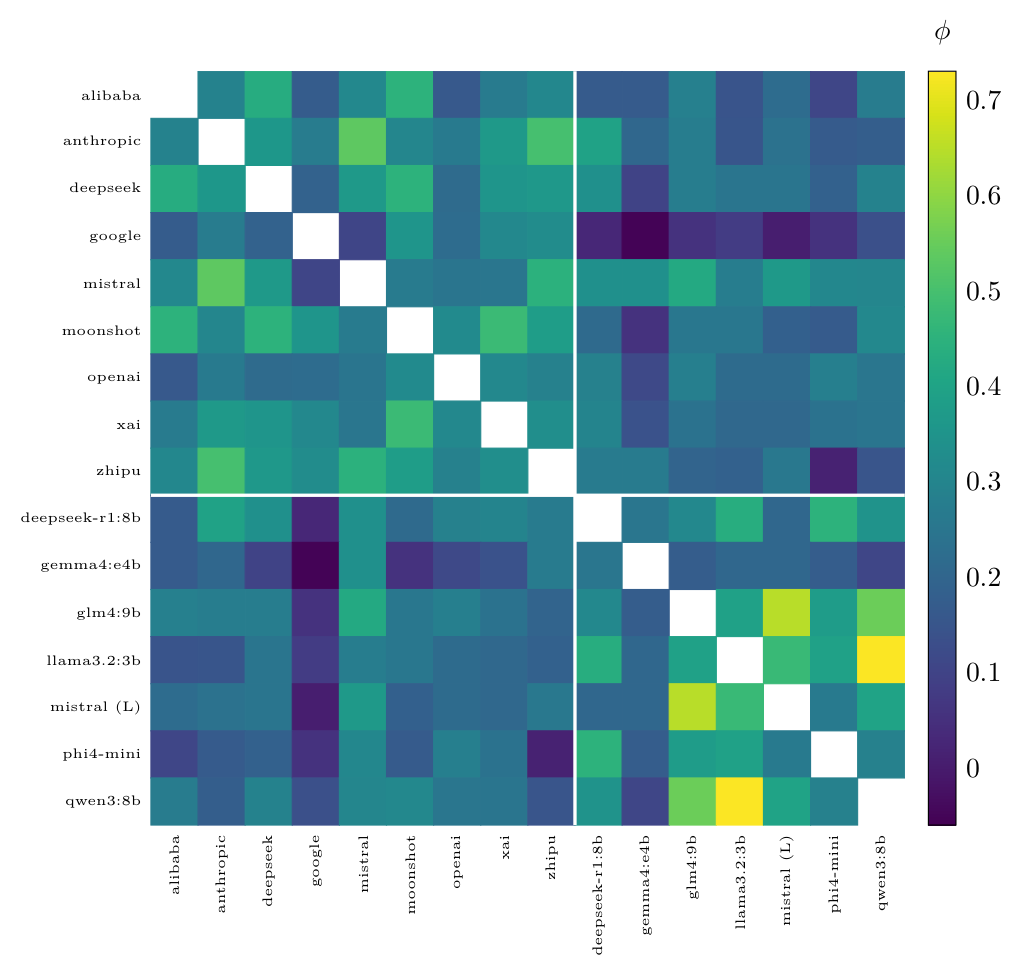 Pairwise error-correlation () among all sixteen models on the 81 questions answered by every model (nine frontier vendors, then seven local open-weights; the frontier/local partition is marked by the white rules). Each off-diagonal cell is one of the 120 unique pairs; the diagonal (self-correlation ) is left blank by design so it does not compress the colour scale. spans to (mean ): a wide spread in how correlated any two verifiers’ errors are, with no detectable bloc effect and, in the pairs measured, no lineage effect. All values are emitted deterministically by a script (
emit_phi_matrix.py, reusing analysis_week1.py); none are hand-entered.
Failure regime IV (exploratory): verification that surrenders
When a verifier that had disagreed blind was shown the same answer as a colleague’s proposal, it capitulated in 38.5% of cases (168/436); when it had produced the correct answer blind, it abandoned it for the wrong one in 30.9% (46/149), with per-vendor abandonment rates from 13.1% to 51.6% (per-vendor capitulation on the full disagreed-blind subset spans 20.4–58.1%).
Could these flips be rational belief updating rather than conformity? A reverse-prompt control argues against it. On a six-model local panel we re-ran the paired procedure with the exposure direction flipped: a verifier that had disagreed blind was shown, for the same question set, either a wrong answer (direct arm) or the gold answer (reverse arm). The two arms are prompt-identical—one shared template (“Proposed answer: …”), the shown answer differing only in content, with no confidence value or source attribution displayed—so the arms hold the prompt fixed and vary which answer is shown, wrong or gold. If verifiers were updating on evidence, exposure to the correct answer should move them more; instead the two arms produced nearly the same flip rate—38.9% toward the wrong answer, 34.7% toward the correct one—and the within-pair comparison runs the wrong way for the updating story: of 174 discordant pairs, the verifier deserted its blind position for the wrong answer in 104 and for the correct one in 70 (McNemar exact ; per-verifier rates in Table 2). At the model level the two arms were indistinguishable (flip propensity 89.9% vs. 89.9% for the most compliant verifier, 1.5% vs. 1.5% for the least): what triggers agreement is that a proposed answer is present, not that it is true. This is what preference-trained sycophancy (Sharma et al., 2024) would look like inside a verifier panel. Nor does the asymmetry depend on the most compliant verifier: excluding it leaves 835 paired items with discordant counts 94 vs. 60 (exact ).
Two further decompositions reinforce this reading (Appendix A): every recorded flip in either arm came with stated post-exposure confidence (0 of 547 below-threshold observations flipped), and in the direct arm verifiers that had been correct blind abandoned the correct answer in 40.8% of cases (20/49), mirroring the frontier finding. The control ran on the local tier (Limitations). A prose summary of this control also appears in the companion paper (Chernets, 2026a); the per-model decomposition, confidence-gate split, and correct-blind abandonment analysis are reported only here.
This bounds a design claim: to measure independent disagreement, elicitation must be blind-first—a panel that deliberates before committing positions does not measure its disagreement, it erases it.
Discussion: why theater may persist
This section is discussion; the evidence is in Sections 4–7. One account of why the regimes persist is that no party is paid to notice them: consumers cannot price verification quality, platforms are paid for confidence rather than doubt, and agreeing is a verifier’s cheapest strategy. Credit ratings paid for by their issuers show where such incentives lead (Dranove and Jin, 2010), and third-party assurance seals in online retailing raise the same question of who certifies the certifier (Özpolat et al., 2013); a verifier paid a fixed fee per check, and assigned by someone other than the party it checks, does not gain from agreeing. In a separate measurement, four model raters agreed with one another more often than human professionals did (56% against 25–28% of pairs within a factor of 1.5), yet their estimates fell within 1.5 of measured times for only 3 of 14 tasks (Chernets, 2026b). The auditor-selection problem (Raji et al., 2022) and the farming of commercially weighted agreement signals point the same way. The account complements simpler ones (engineering inertia, absent measurement standards) and makes one falsifiable prediction: unaudited panels should drift toward low-diversity compositions, because correlated panels are cheaper and agree more.
From theater to measurement
The remedy is a discipline: (1) publish the panel’s measured -matrix per task class instead of its brand list (one blind collection per task class suffices—this paper’s 16-model matrix came from a single 1,500-item pass); (2) stratify every certification claim by difficulty and report the hard-regime lift separately (difficulty is operationalized per task class from a calibration collection, not per item at inference); (3) elicit blind-first, always—the commit-reveal scheme of panel verification, which reorders elicitation rather than adding compute, since blind answers are parallelizable; (4) treat the hardest regime as an escalation trigger—on questions where the panel’s measured lift is , agreement must route to a human or to abstention, never to certification; (5) record every check inside the decision it supports, assembled by the platform’s runtime and not written by the model—who ran it, on which data source, its independence class, and whether it answered blind, shown by commit-reveal (the answer’s hash registered before the choice is displayed) rather than declared—and flag agreement that rests on a single source, so that whoever reviews the decision later can tell a check from its theater. Each rule is stated so that a deployed system can be audited against it.
Rule (4) has an offline and an online part. The threshold (lift ) is calibrated offline, per task class, on a blind calibration collection where population difficulty is observed. At inference a new item’s population difficulty is not observed, so routing needs an online proxy for membership in the hard regime. Building that proxy is the natural next step. Panel agreement cannot be it, since agreement is exactly what fails in that regime.
As a worked example, apply the recipe to this paper’s own frontier panel. Rule (1): its independence is reported as the measured -matrix of Section 6 (span 0.123–0.395). A vendor roster would have concealed that the most correlated pair is intra-bloc (googlexai). Rule (2): its certification lift is reported stratified (Table 1), with the hard-regime lift ( on Q1, on Q2) stated separately rather than folded into a single pooled headline. Rule (3): every answer here was elicited blind before any panel was assembled, which is precisely what makes the conformity arm (Section 7) measurable rather than confounded. Rule (4): because the panel’s measured lift is on the two hardest quintiles under population difficulty, an audited deployment of this same panel would route those questions to abstention or human review, never to consensus certification. Rule (5): every check here is recorded with its model, panel, and mode (blind or in dialogue), which is what makes each regime traceable to the answers behind it. Rules (1)–(3) and (5) are therefore not hypothetical: they are the protocol under which the paper’s own numbers were produced; Rule (4), applied retrospectively, is what those numbers prescribe for this panel.
Limitations
Single benchmark family per tier (SimpleQA open-form frontier; TruthfulQA MC local), so regime boundaries are benchmark-relative; each frontier vendor is represented by one model (budget/mid-tier for eight of nine; Moonshot’s kimi-k3 is its flagship), so vendor-capability claims are not made. Difficulty stratification is observational (post-hoc over a pre-registered collection) and quintile assignment shares data with the models evaluated. The conformity arm is exploratory and modest in ; its reverse-prompt control used local models, so transfer to frontier panels is inferred by analogy. The headline zero spans 106 unique questions and is measured for mid-tier panels; a flagship pair breaks it post hoc (34/37), under a benchmark-exposure caveat. Roughly two-thirds of open-form grades come from an LLM grader (human spot-check 98% agreement; a cross-family regrade of all 342 hardest-quintile replicated verdicts agreed 342/342; sensitivity resampling in the appendix). The headlines hold under 10% synthetic grader noise; a fully human-graded replication would bound larger systematic grader error. Both benchmarks are public, so training-set leakage cannot be ruled out; on SimpleQA its direction favors memorized-correct answers, which shrinks the hard stratum and makes the hard-regime results conservative; on TruthfulQA the public corpus carries the misconceptions themselves, so the direction there is not clear-cut, and the same-question format swap of Section 5 would settle it. The paper measures where agreement fails on hard questions; why it fails is open, with shared priors, shared blind spots, and shared training data as the named possibilities.
Conclusion
Under population difficulty, no replicated answer on the hardest quintile was correct (0/342, across 106 questions; for mid-tier panels, a post hoc flagship pair does not show the zero). Under leave-panel-out difficulty the pooled inversion disappears and the cross-bloc zero remains (0/116). The practical message is that agreement does not certify answers on the questions the deployed population finds hard. Bloc showed no detectable effect on error correlation, and lineage did not predict it in the pairs measured, and the measurement pattern behind these results is what we expect to carry over to other panels. Agreement is evidence only after independence and competence are measured, and the measurement is cheap—the entire re-analysis here runs in under a minute on commodity hardware from the raw graded files. Until panels ship with their -matrices and stratified lifts, “verified by consensus” should be read the way security engineers learned to read a bag search.
Competing interests.
The author is a named applicant on pending patent applications, not granted patents, covering AI orchestration and multi-model validation systems of the kind this paper examines.
Code (reference implementation).
An open-source reference implementation of cross-lab verification on a smartphone (ChatGPT and Claude side by side; no server, no API key): https://github.com/vadimchernets/poly-duo https://polyhelper.ai/duo/. Its modes are not evaluated in this paper; the two-flagship figures are a re-analysis of the companion collection, not measurements of the app.
References
M. Castro and B. Liskov. Practical Byzantine fault tolerance. In OSDI, pages 173–186, 1999.
V. Chernets. Architectural trust: Why consumer trust in agentic commerce migrates from AI models to verifiable architecture. SSRN working paper 7191261, 2026. https://doi.org/10.2139/ssrn.7191261 (cited for the trust construct and for its summary treatment of the shared blind collection; overlapping analyses are cross-flagged where they occur).
V. Chernets. After the programmer divide: One measure for people who build through AI agents. SSRN, 2026. doi:10.2139/ssrn.7589918.
K. Ding. When LLMs agree, are they right? Auditing self-consistency and cross-model agreement as confidence signals. arXiv preprint arXiv:2607.08065, 2026.
D. Dranove and G. Z. Jin. Quality disclosure and certification: Theory and practice. Journal of Economic Literature, 48(4):935–963, 2010.
Y. Du, S. Li, A. Torralba, J. B. Tenenbaum, and I. Mordatch. Improving factuality and reasoning in language models through multiagent debate. In ICML, 2024. arXiv:2305.14325.
S. Farquhar, J. Kossen, L. Kuhn, and Y. Gal. Detecting hallucinations in large language models using semantic entropy. Nature, 630(8017):625–630, 2024.
A. Khan, J. Hughes, D. Valentine, L. Ruis, et al. Debating with more persuasive LLMs leads to more truthful answers. In ICML, 2024. arXiv:2402.06782.
E. Kim, A. Garg, K. Peng, and N. Garg. Correlated errors in large language models. In ICML, 2025. arXiv:2506.07962.
G. Kohli. Nine judges, two effective votes: Correlated errors undermine LLM evaluation panels. arXiv:2605.29800, 2026.
L. Lamport, R. Shostak, and M. Pease. The Byzantine generals problem. ACM Transactions on Programming Languages and Systems, 4(3):382–401, 1982.
S. Lifshitz, S. A. McIlraith, and Y. Du. Multi-agent verification: Scaling test-time compute with multiple verifiers. arXiv:2502.20379, 2025.
S. Lin, J. Hilton, and O. Evans. TruthfulQA: Measuring how models mimic human falsehoods. In ACL, 2022. arXiv:2109.07958.
L. Luu, J. Teutsch, R. Kulkarni, and P. Saxena. Demystifying incentives in the consensus computer. In ACM CCS, pages 706–719, 2015. doi:10.1145/2810103.2813659.
Mastercard. Verifiable Intent: Open specification for cryptographic agent authorization in commerce (draft v0.1). Specification repository, 2026. https://github.com/agent-intent/verifiable-intent.
K. Özpolat, G. Gao, W. Jank, and S. Viswanathan. The value of third-party assurance seals in online retailing: An empirical investigation. Information Systems Research, 24(4):1100–1111, 2013.
I. D. Raji, P. Xu, C. Honigsberg, and D. Ho. Outsider oversight: Designing a third party audit ecosystem for AI governance. In AIES, pages 557–571, 2022.
B. Schneier. Beyond Fear: Thinking Sensibly About Security in an Uncertain World. Copernicus Books, 2003.
M. Sharma, M. Tong, T. Korbak, D. Duvenaud, et al. Towards understanding sycophancy in language models. In ICLR, 2024. arXiv:2310.13548.
D. Shehata and M. Li. The inverse-wisdom law: Architectural tribalism and the consensus paradox in agentic swarms. arXiv:2604.27274, 2026.
P. Verga, S. Hofstätter, S. Althammer, Y. Su, A. Piktus, A. Arkhangorodsky, M. Xu, N. White, and P. Lewis. Replacing judges with juries: Evaluating LLM generations with a panel of diverse models. arXiv:2404.18796, 2024.
J. Wei, K. Nguyen, H. W. Chung, Y. J. Jiao, S. Papay, A. Glaese, J. Schulman, and W. Fedus. Measuring short-form factuality in large language models. arXiv:2411.04368, 2024.
H. Zhang, Z. Cui, J. Chen, et al. Stop overvaluing multi-agent debate—we must rethink evaluation and embrace model heterogeneity. arXiv:2502.08788, 2025.
Reproducibility appendix
All re-analysis is deterministic given the raw graded JSONL files and fixed-seed scripts: a baseline script reproducing every headline number, a week-1 add-on producing the bootstrap, sensitivity, and decomposition tables below, and sensitivity scripts for leave-panel-out difficulty, label-free coding, the correlated nulls, , the Q1 profile, and the local open-form comparator. The cross-family regrade and the manual adjudication of the 106 Q1 questions are published as verdict files. Recomputing every number from these files takes about a minute on commodity hardware with no GPU, network, or model calls. The frozen pre-registration and replication package (public OSF registration): https://osf.io/4y9dv. The frozen package holds the protocol, the 1,500-item subsample, the collection and grading scripts, and the raw graded answer files. All re-analysis scripts and verdict files run on those raw files and are public in the replication component https://osf.io/jtvu9/ (folder verification-theater-analysis, whose README maps each script to the numbers it prints). Exact model identifiers as called, runner settings, and serving provenance are in the public run manifest (replication-package-v2/RUN-MANIFEST.md). The four local panels are pilot (qwen3:8b, gemma4:e4b, llama3.2:3b), US-local (gemma4:e4b, llama3.2:3b, phi4-mini), CN-local (qwen3:8b, deepseek-r1:8b, glm4:9b), and cross-bloc (gemma4:e4b, qwen3:8b, mistral).
Bootstrap confidence intervals for the lift ladder
Question-level resampling within quintile, 2,000 seeded draws, pooled over the three frontier panels.
| Quintile | Wilson 95% | Boot 95% | Lift | Lift boot 95% | |
|---|---|---|---|---|---|
| Q1 (hardest) | 0/342 = 0.0% | [0.0, 1.1] | [0.0, 0.0] | 0.00 | [0.00, 0.00] |
| Q2 | 46/359 = 12.8% | [9.7, 16.7] | [8.2, 18.2] | 0.82 | [0.51, 1.21] |
| Q3 | 272/473 = 57.5% | [53.0, 61.9] | [50.7, 64.6] | 2.68 | [2.32, 3.09] |
| Q4 | 732/904 = 81.0% | [78.3, 83.4] | [76.6, 85.1] | 3.09 | [2.84, 3.35] |
| Q5 (easiest) | 1700/1788 = 95.1% | [94.0, 96.0] | [93.4, 96.6] | 4.56 | [4.16, 5.03] |
Certification lift by difficulty quintile with Wilson and bootstrap 95% intervals (percentages for , ratios for lift). Under leave-panel-out difficulty (ranked by the 13 non-panel models) the pooled Q1 cell is 78/354 (22.0%, lift 2.36), the zero persisting for the cross-bloc panel (0/116); Section 4. Base rates per quintile: 3.9 / 15.6 / 21.5 / 26.2 / 20.8% ( = 2286 / 2308 / 2209 / 1778 / 912).
Grader-error sensitivity
Flipping 10% of the 8,948 model-graded frontier verdicts (200 seeded resamples; agreement coding and quintile assignment frozen at the original deterministic protocol coding so that only correctness labels move): the hardest-quintile “certified correct” cell rises from 0/342 to a median of 33/342 (9.6%; 95% range 23–46), so the certified-error share of Q1 agreement stays at or above 86.5% in every resample; the Q1 lift stays below 1 in 92% of resamples (median 0.82, 95% range 0.56–1.08) while the Q3–Q5 lifts never fall below 2 (medians 2.17 / 2.51 / 3.42). Of the 342 Q1 replicated answers, 332 (97.1%) are model-graded and therefore flippable in this exercise. Beyond synthetic flips, a cross-family audit regraded all 342 Q1 replicated verdicts with an independent second grader (a vendor family outside every panel and outside the original grader’s family; temperature 0; byte-identical frozen prompt): agreement 342/342 (flips to correct 0/342, Wilson upper bound 1.1%), uniform across model-graded (332) and string/refusal-coded (10) cells. Because the 342 cells span 106 unique questions, a cluster-conservative reading treats questions as the unit: 0/106 gives a Wilson upper bound of 3.5%; the permutation null of Section 4 already works at cluster level.
Reverse-prompt control: per-model decomposition
Six local models, 2,399 valid paired observations; flip = the verifier abandons its blind answer for the shown one.
| Verifier | Direct (to wrong) | Reverse (to correct) | Diff |
|---|---|---|---|
| qwen3:8b | 204/227 = 89.9% | 196/218 = 89.9% | pp |
| mistral | 132/213 = 62.0% | 113/203 = 55.7% | pp |
| glm4:9b | 66/213 = 31.0% | 39/200 = 19.5% | pp |
| llama3.2:3b | 40/234 = 17.1% | 38/227 = 16.7% | pp |
| gemma4:e4b | 33/202 = 16.3% | 19/195 = 9.7% | pp |
| phi4-mini | 2/137 = 1.5% | 2/130 = 1.5% | pp |
| Pooled | 477/1226 = 38.9% | 407/1173 = 34.7% | pp |
Flip rates by verifier and arm. Paired recount: 1,028 items present in both arms (296 flipped in both, 558 in neither); discordant pairs 104 (wrong-only) vs. 70 (correct-only), exact binomial McNemar (asymptotic ). All 884 recorded flips carry stated post-exposure confidence ; 0 of 547 below-threshold observations flipped.
MC certified-consensus-error by TruthfulQA category
Pooled over the four pre-specified local panels (events per item-panel; categories with at least 20 items): Economics 8.6%, Fiction 6.2%, Paranormal 6.0%, Law 5.9%, Superstitions 5.7%, Stereotypes 5.4%, Sociology 4.9%, Health 4.9%, Misconceptions 2.6%, Conspiracies 1.0%.
The 4.6% upper end rests on the one local panel sharing only 87 items with the reasoning model’s 98 gradable answers; excluding it, the strict local open-form range is 1.5–1.8%.↩︎
How to cite
Chernets, V. (2026). Verification Theater: Measured Failure Modes of AI Verifier Panels [Paper presentation]. NeurIPS 2026 Workshop: Who Verifies the Agents?. Zenodo. https://doi.org/10.5281/zenodo.23197641
@misc{chernets2026verificationtheater,
  author       = {Chernets, Vadym},
  title        = {{Verification Theater: Measured Failure Modes of AI Verifier Panels}},
  year         = {2026},
  howpublished = {Zenodo; NeurIPS 2026 Workshop: Who Verifies the Agents?},
  doi          = {10.5281/zenodo.23197641},
  url          = {https://doi.org/10.5281/zenodo.23197641}
}