Can You Trust AI Answers When ChatGPT and Claude Agree? A Free Check for AI Memory
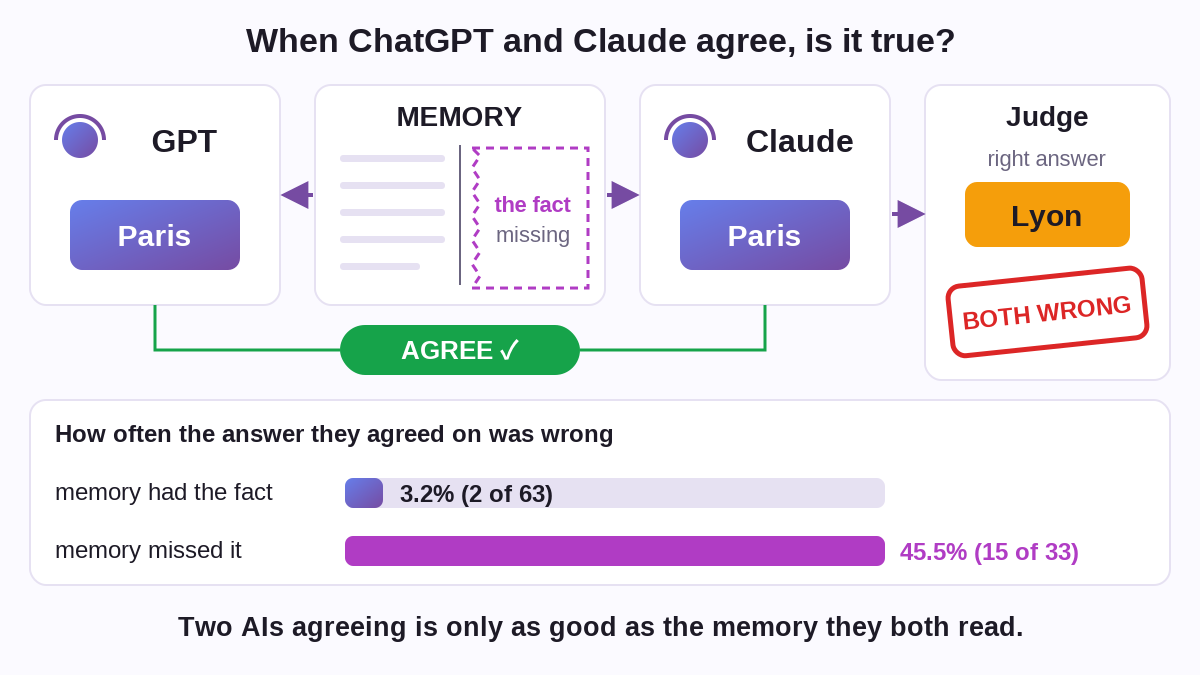
When two AIs from different companies give you the same answer, it feels settled. ChatGPT says it, Claude says it, so it must be right. memory-agreement-check is a free, open-source tool that tests that feeling in one particular place: an AI assistant with a memory. If both models read the same notes and the notes are missing the fact, can they both be wrong in the same way?
The tool answers with numbers. It takes questions about long conversations, gives two models from two different companies the same retrieved notes, grades their answers, and counts how often they agree and are both wrong. It also splits those counts by whether the notes actually held the fact.
Why "two AIs agree" is not the same as "it's true"
Asking several AIs the same question is now a common habit. Type "ask multiple ai" into Google and it offers "...at once", "...at the same time" and "ask same question to multiple ai". The idea is the one behind a second opinion from a doctor: if two independent experts agree, you can relax.
The catch is the word independent. A 2025 study of over 350 language models found that when two models are both wrong, they pick the same wrong answer about 60% of the time (Kim et al., ICML 2025). And people lean on these answers: in an April 2026 survey of 2,127 US adults, 78.5% had made a real-life decision based on an AI tool, while 17.4% always check what it says (National Law Review).
An assistant with memory adds a second, simpler reason. Such an assistant does not reread everything you ever told it. A search step (called retrieval: fetching the few past messages that look most relevant) picks a handful of notes and hands them to the model. If you put two models behind the same memory, they both read the same handful. When the retrieval step misses the key message, both are working from the same incomplete page.
What the first run found
The repository holds one full run, from 11 November 2026, with every answer and grade saved. It used 200 questions from LoCoMo, a public test set of very long chats between two people, with questions such as when someone did something or what they said months earlier. The memory was a simple keyword search that pulled the 10 most relevant chat turns. OpenAI's gpt-6.1-sol (through the Codex command-line app) and Anthropic's claude-sonnet-5-5 (through Claude Code) answered separately, neither seeing the other's answer. A model from a third company, Kimi by Moonshot, graded the answers blind: it did not know which model wrote which.
On the 156 regular questions whose evidence could be traced:
- When the memory held every needed turn, the two models gave the same real answer 63 times, and it was wrong 2 times (3.2%).
- When the memory missed part of the evidence, they gave the same real answer 33 times, and it was wrong 15 times (45.5%), close to a coin flip.
- Their mistakes moved together: both were wrong on 40% of questions, where 20% would be expected if their mistakes were unrelated.
- Grading with LoCoMo's own word-overlap rule instead of the AI judge gives the same picture: 12% wrong with full memory against 66% with incomplete memory.
In plain words: agreement between the two was a good sign when the memory was good, and a weak one when the memory was not. Before you trust two agreeing AIs, check whether they had the facts to work with.
The repository's results page lists exactly what this run covers (one search method, one model pair, one judge, 200 questions) and gives every table with 95% ranges, so you can see how firm each number is.
Who it is for
- People building an AI assistant with memory who want to know whether "ask two models and trust the overlap" is a safe check for their own system.
- Anyone testing a retrieval system (often called RAG, retrieval-augmented generation). You can plug in your own memory and see how many shared wrong answers it causes, compared with the built-in keyword search.
- Teams comparing two versions of one model, for example a full-precision build against a compressed one (FP8 versus bf16, two ways of storing a model's numbers, the second one larger and more exact). The
comparemode tells you whether the two really differ on your questions, or whether a handful of changed answers is just noise.
What it does, step by step
For each question, the tool:
- Fetches memory: either its own keyword search over the chat, or the notes your own system returns, given as a simple file with one line per question.
- Asks two models separately, with the same instructions: use only these notes, answer in a few words, and say "Not mentioned" if the answer is not there.
- Grades both answers two ways: a blind judge model from a third company, and LoCoMo's word-overlap score.
- Reports each model's accuracy, how often they agree, how often they agree and are both wrong, split by question type and by whether the memory held the evidence.
The compare mode works on any set of questions, not only LoCoMo. Give it two files of answers and it returns a side-by-side table, a standard test for paired results (McNemar's test), a range for the accuracy difference, how often the two gave word-for-word identical answers, and how many questions you would need to spot a 1, 2 or 3-point drop. A worked example in the repository, contributed by Anagha Langhe of DocumentSyncAI, compares an FP8 and a bf16 build of Qwen2.5-7B on 120 questions: 1 changed answer out of 120, and on the 48 questions both builds got wrong, the same wrong answer 42 times.
How to start
You need Python 3.10 or newer and nothing else; the tool has no required add-ons. Open a terminal and run:
git clone https://github.com/vadimchernets/memory-agreement-check
cd memory-agreement-check
python -m memcheck download
python -m memcheck run --backend dry --n 200
The third line fetches the LoCoMo data from its official home and checks it is the exact file the tool expects. The last line is a dry run: stand-in models that answer offline in seconds, so you can see the whole report before spending anything.
Then pick how the real models are reached:
- With your subscriptions, no API keys (an API key is the access code programs use to call an AI). If you have the
codexapp for a ChatGPT plan, theclaudeapp for a Claude plan and thekimiapp installed, use--backend cli. Codex runs read-only and Claude with all tools switched off, so the models only read. - With API keys. Set
OPENAI_API_KEYandANTHROPIC_API_KEY, use--backend apiand name the two models yourself. - With your own memory. Run
python -m memcheck export-questions --out questions.jsonlto get all 1,986 LoCoMo questions, have your system return its notes for each, and pass them with--contexts my_contexts.jsonl. An included example does this with FlyHash, a compact memory method from a 2026 paper.
A run saves each answer as it goes, so if it stops, the same command picks up where it left off. --pace adds a pause between questions so a subscription's limits are not hit.
Where it comes from
memory-agreement-check is written by Vadym Chernets, released under the MIT licence, version 0.1.0 of 11 November 2026, with 21 automated tests. The LoCoMo data is not bundled: the tool downloads it from the LoCoMo authors, whose CC BY-NC 4.0 licence (free for non-commercial use) applies to the data. It continues two papers by the same author: Agreement Is Not Independent Evidence and Agreement Inversion Is Not a Mid-Tier Property. For everyday use the same idea lives in Poly Duo, which lets your own ChatGPT and Claude check each other on your phone, free and open source, so you can watch two models agree, disagree, and sometimes agree on the same mistake.
The code, the full results and the instructions are at github.com/vadimchernets/memory-agreement-check, and if it helped you, a star there takes one click.
View memory-agreement-check on GitHub
Vadym Chernets also builds Poly, an app in which AIs from different companies check each other's work.