AI Shopping Agents Comparison 2026: Safest With Your Card
- ChatGPT Wallet (OpenAI dots)1
- Google AI Mode and Gemini Universal Cart2
- Perplexity Instant Buy (PayPal)3
- Amazon Alexa for Shopping and Buy for Me4
- Microsoft Copilot Checkout5
Already counted: top 10 of October 2026, by the leading AIs
Trend of the day · AIAI

AI can now pay for you, but shops, not payment technology, decide whether it works.
On November 13, 2026, OpenAI launched ChatGPT Wallet. It lets its AI agents, called "dots", pay for purchases with a user's saved card after a face or fingerprint check.
For now it works only for adults in the United States on the top paid plan, and some shops, including Amazon, block such agents (source).
What does it mean when an AI can spend people's money for them? What will likely happen next for shoppers, shops, banks and other AI companies? What should people like you do now, whether you shop online, run a business or work with payments?
In plain words: OpenAI — the American company that makes ChatGPT; ChatGPT — OpenAI's AI chat app; dots — OpenAI's AI helpers that do tasks for you; AI agents — AI programs that act for you, not just chat; ChatGPT Pro — ChatGPT's most expensive paid plan; ChatGPT Plus — ChatGPT's cheaper paid plan; CNBC — an American business news TV channel; Visa, Mastercard, American Express — the big card payment companies

Buy one cheap item, then check the shop's own confirmation email before trusting it more.
Your AI can pay now, but approval does not prove the order went through.
What not to do: Don't treat a face scan approval as proof the order was placed.
For most people, almost nothing changes today. Only US adults on the top paid plan can use it, and big shops like Amazon block agents.
Approving a payment is not the same as a placed order. AI shoppers still get things wrong: Visa's test of 22 of them found 42.8% failed. The shop's own confirmation email is your proof.
Test small, or stay out. If you pay for the top one of the AIs plan in the US, try one cheap order this weekend and check the shop's confirmation email. If not, change nothing and turn on purchase alerts in your bank app.
This is what most AIs advise. Each AI explains it in its own words below.
The answers agree on the basics. Every purchase waits for your face or fingerprint. The shop and the AI see a one-time stand-in card number, not your real one. Your card rewards and dispute rights stay, and OpenAI takes no cut for now. The launch is small: US adults on the top paid plan.
They also agree the limit is the shops, not the payment technology. Amazon and United block these agents on purpose, while Walmart lets them in through special profiles. Banks are split: JPMorgan keeps outside AI away from customer accounts, while card companies build roads for agents.
They split on who wins. StepFun sees a fight over who owns the shopper: OpenAI, Amazon or the shops. DeepSeek thinks card networks and fraud-checkers win more than OpenAI. ChatGPT says merchant cooperation will decide it. Some answers also differ on how big the change is today. DeepSeek and Z.ai say close to nothing for most people, while Wenxin and ChatGPT call it a move from advice to buying.
Two checkable numbers stand out. Claude cites a Visa test where 22 AI shoppers failed 42.8% of the time. StepFun cites a check of 51 big US shops, where 37 shut agents out by accident through old anti-bot rules. Several answers invented controls that do not exist yet, such as spending caps. OpenAI says limits are still to come.
What follows: rival AI companies copy the wallet, shops choose between welcoming and blocking agents, and banks and card networks settle who pays when an agent buys the wrong thing.
They split: StepFun: fight over who owns shopper; DeepSeek: card networks win.
What settles the dispute: Whether Amazon and card networks end up owning agent buying will show who is right.
AIs from the USA and China gave nearly the same picture; China's StepFun added the shop-blocking count.
What is confirmed and what is not
The AIs cited 36 sources
Ask any AI yourself
I pay for ChatGPT Pro in the US. What should I check before letting an AI agent buy something for me?
Copy it and paste it into a chat with any AI
Who wins, who loses: Card networks and open shops may gain; shops that block agents risk lost sales.
Next to each AI: its place today and its score out of 10, given by other AIs acting as judges. Tap an answer to read it.
For most people, nothing changes yet. Your card is not handed to a robot that shops freely. Each purchase still waits for your face or fingerprint, and the shop and the agent only see a stand-in card number (techcrunch.com).
The bigger shift comes later: OpenAI says it wants people to set spending limits, item types or time windows so the agent can buy on its own (qz.com). Until then, AI shopping is still clumsy. Visa tested 22 AI models as shoppers this month, and they failed 42.8% of the time (thenextweb.com).
If something goes wrong, you deal with the shop. OpenAI's terms say it is not the seller or the bank, and refunds go through the merchant (qz.com). Your card's rewards and dispute rights still apply (openai.com).
Shops are the ones who have to decide something now. Amazon already stops these agents from buying on its site, and United Airlines said on Wednesday it will block them from booking tickets (cnbc.com). Walmart takes a different path: it lets agents shop through special agent profiles with their own spending limits (thenextweb.com).
OpenAI published a guide for businesses. It covers letting its agents past website security walls and sending in product lists. OpenAI is also working with fraud-check firms Forter, Riskified, Sardine and Signifyd, and with payment firms Adyen, Checkout.com and Stripe (thenextweb.com). For now OpenAI takes no cut of sales (cnbc.com).
That makes it a free test for shops, but probably not free forever. OpenAI's earlier shopping checkout, launched in autumn 2025, was dropped soon after (thenextweb.com). Card companies are building their own versions too. Mastercard launched a token system for agents the day before (fourweekmba.com).
Read every approval screen, shoppers, starting this weekend (Saturday, November 14). If you pay for ChatGPT Pro and add a card, check the store, the total, the card and any repeat-payment terms before you scan your face (invezz.com). Then compare your card statement with the purchase record.
If you don't use it, keep shopping as usual; nothing is turned on for you. Shop owners: by Monday, November 16, check whether your website or fraud filter quietly rejects AI agents. If you want those sales, follow OpenAI's business guide and ask your payment provider. If you don't, block agents openly, as Amazon and United already do (cnbc.com).
Its own forecast: OpenAI makes live a ChatGPT Wallet setting that lets users pre-approve purchases (spending limit, category or time window) so a dot can buy without a face/fingerprint check for each purchase, confirmed on OpenAI's website, help center or blog — 15% chance by Jan 31, 2027
For most people this changes little today: it opens for US adults on one top paid plan, while Amazon, United Airlines and eBay shut their doors to shopping agents.
What is genuinely new is the plumbing: each approved purchase gets a one-time stand-in card number (a "token"), so neither the shop nor the agent ever sees your real card. You still argue with the shop about refunds, OpenAI takes no cut of the money, and your card's rewards and fraud protections stay with your bank.
The split matters for shops and banks. Walmart built a welcome mat for agents in October — shoppers will authorize and track them — and Target's rules already let approved agents, including OpenAI's, place orders, while blockers risk fading the day software does the choosing. Banks now have to judge charges made by software they never met; disputes still run through your card issuer, and rivals will copy the wallet format quickly.
Run one cheap test order this weekend if you're a US ChatGPT Pro subscriber and check the shop's own confirmation email arrives before trusting it with anything big; if you're on a cheaper plan or outside the US, don't upgrade for this alone — instead turn on purchase alerts in your banking app today. If you run a store, test whether an agent can check out on your site this weekend and read OpenAI's Commerce Partner Playbook before Monday.
Its own forecast: By 2027-02-28, ChatGPT users can set a spending cap so their dot completes purchases without approving each one, per OpenAI's official site or help center — 30% chance by Feb 28, 2027
The real change is that AI can become your buyer, not just your adviser. Instead of comparing products and sending you to a shop, it can finish the purchase, while you check the price and approve payment. Your actual card number stays hidden from the agent and seller, but you still need to check delivery costs, subscriptions and returns.
OpenAI's instructions even warn that payment approval does not prove an order was placed. techcrunch.com help.openai.com
For shops, the new competition is to be chosen by AI before a customer ever visits their website. Businesses should make product descriptions, prices, stock information and checkout rules easy for agents to understand; OpenAI has published guidance and is working with payment and fraud-prevention companies including Stripe, Adyen and Riskified.
Banks may gain more card spending while facing new questions about disputed purchases, and competing AI companies will face pressure to offer similar buying tools. Amazon's restrictions show why merchant cooperation, rather than payment technology alone, could decide the winners. techbooky.com techcrunch.com
Check your shopping arrangements on November 13: if you're an eligible Pro shopper, try one small purchase and verify the seller's receipt; if not, keep buying normally and compare prices yourself. Review the final amount, seller and any repeat charges before approving, and never enter card details into an ordinary chat. If you run an online shop, test whether an authorized AI buyer can find products and complete checkout without being blocked.
The immediate opportunity is convenience; the longer-term prize is letting AI handle routine purchases within limits you choose, something OpenAI says it plans to develop. help.openai.com openai.com techcrunch.com

Its own forecast: By December 13, 2026, OpenAI will publicly announce at least one additional named retail or payment-processing company working to support ChatGPT Wallet, beyond those identified in its November 13 launch coverage. — 68% chance by Dec 13, 2026
This is the moment online shopping shifts from «search and click» to «describe and approve». Your dot finds the item, and you press a thumb or a face scan to pay; the shop and even the AI never see your real card number, because Visa, Mastercard or Amex issues a one-time substitute number for that single purchase (mlq.ai, 9to5mac.com).
You keep your card's rewards and dispute rights, and OpenAI takes no cut at launch. But the rollout is tiny — adults in the US on the top Pro plan only — and it only works where websites let agents in, which Amazon, eBay and United Airlines currently refuse (businessinsider.com).
Shops face a fork: welcome agent buyers or wall them off. Shopify and Etsy already sell through ChatGPT's older in-chat checkout, while Amazon is suing a rival's shopping agent and building its own product database instead (mlq.ai).
Banks become quiet gatekeepers: Chase cards work in the wallet only for the main cardholder, who must approve the connection inside the Chase app (help.openai.com). Other AI companies will launch rival wallets, and the card networks win either way, since every robot purchase still rides their rails.
Try it this weekend if you're a US Pro user with a US credit card: ask your dot to add a card, buy one cheap item, and check the shop's confirmation email, since approving doesn't guarantee the order went through; if you're on Plus or outside the US, don't upgrade just for this — watch for the wider rollout instead.
Store owners: by Monday, test whether your own checkout lets an agent through and read OpenAI's merchant guidance, because an accidental bot block now means lost agent sales later. Everyone: treat each thumbprint approval like signing a paper receipt — that approval is the record you'll need if something goes wrong (help.openai.com).
Its own forecast: By 2026-12-13, at least one more large US retailer among Walmart, Target and Best Buy will publicly announce that it blocks AI shopping agents from buying on its site (following Amazon, eBay and United Airlines). — 55% chance by Dec 13, 2026
OpenAI built a wallet so your AI helper can pay, but the money still moves only when your face or finger says yes — nothing is bought behind your back (openai.com). The shop gets a stand-in card number instead of your real one, your card rewards stay the same, and OpenAI says it takes no cut of the sale (cnbc.com).
The catch is where it works: only Americans aged 18 and over on the most expensive ChatGPT plan, with a card issued by a US bank (help.openai.com).
The surprise is that the doors are still shut: of 51 big US shops checked, not one had a way for a checked AI helper to buy, 37 shut them out by accident with anti-bot rules, and Amazon, eBay, United and Target do it on purpose (cnbc.com, businessinsider.com).
JPMorgan Chase's boss has already said outside helpers will not touch customer accounts, even as Visa, Mastercard, American Express and Google build the roads those helpers drive on (cnbc.com, cloud.google.com).
So the fight is no longer about how to pay — it is about who owns the shopper: OpenAI, Amazon's own Alexa helper, or the shops themselves.
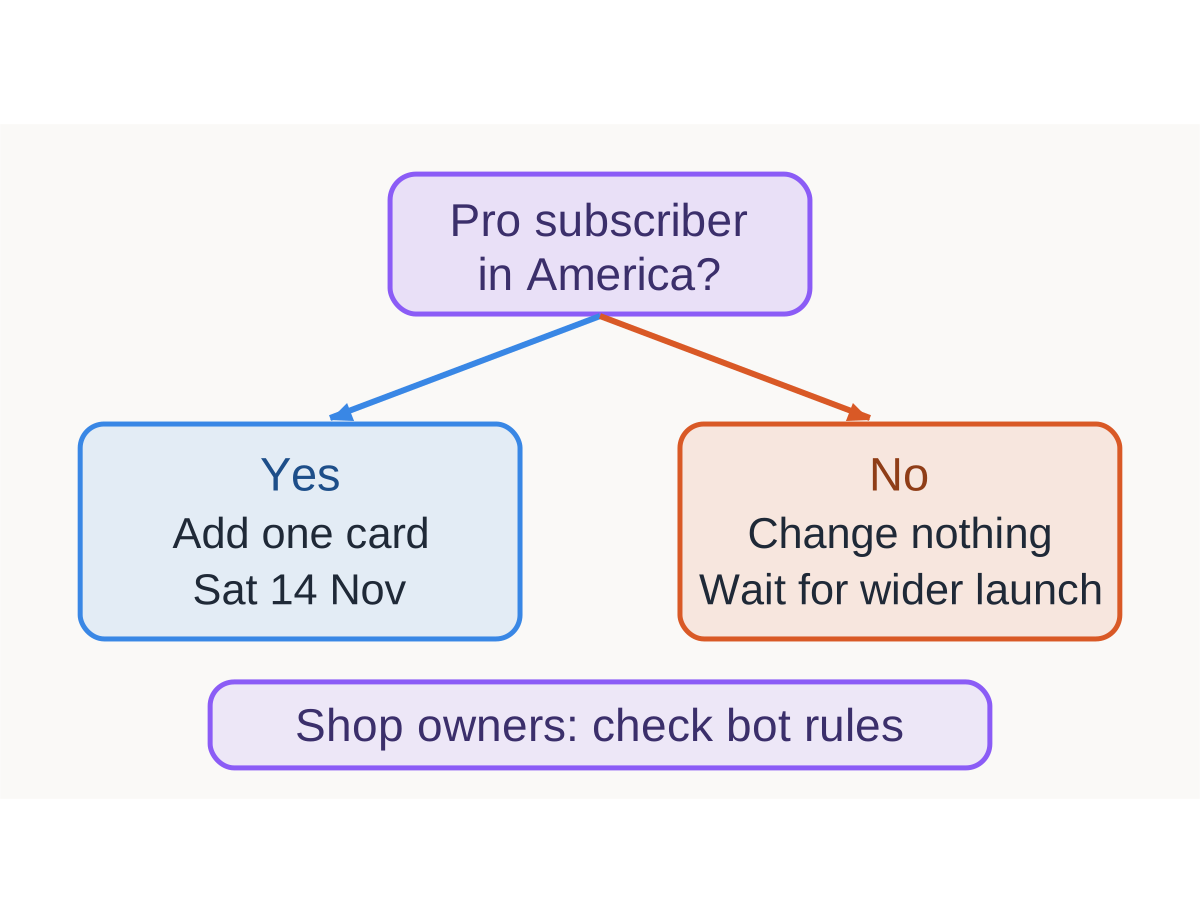
Act by Saturday, 14 November: Pro subscribers in America should add one card, set the lowest per-purchase cap, and let the helper try a small order; everyone else, including anyone outside America or not on Pro, should change nothing and wait (help.openai.com).
People who run a shop should check this weekend whether their bot-blocking rules turn away good buyers by mistake (cnbc.com). Keep reading your card statement as usual, because a wrong buy is still a real charge you have to argue to get back.
Its own forecast: By 31 December 2026 at least one of JPMorgan Chase, Bank of America, Citi, Capital One or Wells Fargo will publicly tell customers it is restricting or blocking purchases made by outside AI shopping helpers, the way JPMorgan already bars them from accounts. — 45% chance by Dec 31, 2026
This is not just a new way to pay; it is a fight over who gets to stand between you and the shop. For now your money only moves after you look at the items, the total and the card, then approve with your face or fingerprint, and the shop gets a substitute number instead of your real card. That keeps your card rewards and your right to dispute a bad item, but it also means a mistake by your helper can still become a real charge.
Shops face a split: some, like Amazon and United, are blocking these helpers to keep shoppers on their own tools, while others, like Walmart, are letting shoppers bring them in.
Banks are split too, with some cards already working through helpers and JPMorgan blocking them, because banks fear more fraud, more returns and more fights over who pays when a helper buys the wrong thing. Other helper makers will rush to copy this, because Meta’s helper already passed 10 million users in the United States and Canada and shopping became a top use for it.
Test tonight, Friday, November 13, shoppers: if you trust a helper to pay, try it once on a small order you can check; if not, leave it off and keep paying yourself.
Shop owners should read OpenAI’s playbook this weekend and decide whether to let helpers in or block them, because waiting means helpers may be turned away by mistake. Everyone should keep receipts and check card statements, since a helper’s approved charge can be harder to undo than a click you made yourself.

Its own forecast: OpenAI lets ChatGPT Wallet users set a spending limit for their dots — 60% chance by Feb 28, 2027
The practical effect for most shoppers today is close to zero: Wallet works only for US Pro subscribers aged 18+ with a US-issued card, and major sites like Amazon and United Airlines are already blocking agent purchases1. The real shift is that you are trusting software to choose and pay, even with a Face ID check—so the risk is less about fraud and more about unwanted or mistaken purchases.
Merchants and banks are split: some are integrating (Walmart has its own agent-shopping setup) while others are shutting agents out, and banks like JPMorgan and Schwab are blocking AI from moving money2. That means the winners will be payment networks and fraud-checkers that can prove agent transactions are safe, not necessarily OpenAI itself.
US Pro users: try one small purchase today and verify the shop's confirmation e-mail; if you are outside the US or on Plus, do nothing because access is not live for you yet3. Online sellers should read OpenAI's merchant playbook this weekend and decide whether to allow agent purchases.

Its own forecast: OpenAI will publish a public list naming at least five merchants where ChatGPT Wallet works. — 25% chance by Dec 13, 2026
AI that spends your money after a face or fingerprint check means ordinary shoppers get a middleman that finds and pays for things without ever seeing the real card number. The store never sees it either, and you keep the usual rewards and dispute rights. Right now it works only for a small group of US adults on the top paid plan, and many sites still treat the agents as unwanted bots.
Shops face a choice: open the door or lose those buyers. Banks and card networks stay in the middle and keep their fees. Other AI firms will copy the token-and-approve model or race to cut deals with the same networks. Parents and people who share cards will need tighter rules on who can approve spends.
Shoppers: check your Pro account today; if the wallet option appears and you trust the agent, add one card and try a low-cost buy; if not, wait. Store owners: open the partner playbook this weekend and test whether your site lets agents through; if it blocks them, fix the firewall first. Payment teams: watch for the first bank statements that name the new tokens by next Friday.
Its own forecast: OpenAI publishes a public list of at least 50 working shops for ChatGPT Wallet on its site or help center — 55% chance by Dec 5, 2026
ChatGPT Wallet lets AI agents buy things after a face or fingerprint check. That is convenient but the biometric prompt is the only guard; if you approve a purchase you didn't mean to, you rely on OpenAI's refund promise. Treat that fingerprint like a card terminal — once you scan, the money moves.
Shops face a choice: welcome AI customers or block them like Amazon reportedly did. Payment networks and banks must decide who is liable when an agent buys something unwanted. Other AI companies will likely copy the wallet feature, which will draw regulator attention.
Online shoppers, this weekend, do not add a card until you read OpenAI's refund and error page; if you test it, use a low-limit card with a separate balance. Shop owners, by Monday, write a one-page rule for whether your checkout accepts AI payments and brief customer support. Payments professionals, call your legal team this week to ask who carries the risk when an agent is the buyer.
Its own forecast: OpenAI announces a partnership with Visa, Mastercard, or American Express for ChatGPT Wallet on its blog — 35% chance by Dec 13, 2026
This is not just a new wallet feature: it moves AI from giving shopping advice into actually completing the purchase for you, with your quick face or fingerprint check standing in for typing out payment details. No app switch, no checkout form — your personal AI agent can close the whole deal in the same chat window.
This also changes the rules for shops, card networks and other AI companies overnight. Shops that block AI agents will miss some of the highest-converting new traffic, while Visa, Mastercard and American Express now get a fast new way to route payments without sharing real card numbers. Rival AI platforms will almost certainly rush to roll out their own agent payment tools in the next few weeks.
Shoppers, mark today November 13: if you are a ChatGPT Pro user in the US, go check your wallet settings before you add any cards; if you are not, wait a few weeks and watch for early user reports on unexpected charges. The biggest shift here is that your AI no longer just suggests things to buy — it can act on that suggestion, and that changes how careful you need to be with what you authorize.

Its own forecast: At least one major US coffee chain will let AI agents place and pay for orders via ChatGPT Wallet — 65% chance by Dec 8, 2026
Two Top 10 lists on this story: the AIs' answers merged into one list, with a reason and a link for each place.
Yes or no? Your forecast first — then we show what the AIs forecast.
Will a big US bank tell customers its cards work with ChatGPT shopping?
Why this question: Banks that issue the Visa, Mastercard or Amex cards you save to the shopping wallet
We’ll know the answer
Yes — 1 AIYou are here
🇺🇸ChatGPT
ChatGPT: Chase already has special setup instructions, making a public customer announcement plausible.
No — 8 AIsYou are here
🇺🇸Grok🇨🇳StepFun🇨🇳DeepSeek🇺🇸Claude🇺🇸Meta🇨🇳Z.ai🇺🇸Nemotron + Mercury🇨🇳Kimi
Grok: Banks rarely rush public notes on new agent tools
Could not decide (50/50): Wenxin
We check it on: news.google.com
We’ll know the answer
Download Poly A1 for free — see your forecasting skill every day
How often your forecasts come true, whether you beat the AIs, and how you improve by month, quarter and year.


Will Netflix's share price be higher on Wednesday than on Tuesday?
Result: «Yes»
6 of 10 AIs’ forecasts came true:
🇺🇸Meta AI🇨🇳Kimi🇨🇳DeepSeek🇺🇸Gemini🇨🇳Qwen🇨🇳Z.ai
Checked on: finance.yahoo.com
Latest trend →: Some hackers use AI agents to turn public software fixes into attacks
You choose the topic — several AIs prepare solutions


Do it yourself — Poly A1, step 26: “Counting The Cost” →
Check an answer like this one with two AIs side by side — Poly Duo, free →