best ai agent frameworks 2026
- CrewAI1
- OpenAI Agents SDK2
- AutoGen3
- LangGraph4
- Vercel AI SDK5
Already counted: top 10 of October 2026, by the leading AIs
Trend of the day · AIAI
Money is now going to the tools that watch AI agents, so checking an agent's work is the skill that counts.
On November 13, 2026, the American company LangChain said it raised $300 million at a value of $3 billion. That is more than twice its value a year ago.
The round was led by CapitalG, an investment fund of Google's parent company, Alphabet. LangChain says more than 7,000 organizations use its LangSmith platform to run, test and control AI agents, which are AI programs that carry out tasks on their own (source).
What does this deal say about where AI agents at work are heading, and what could change next? What should people like this page's readers do now: people learning to move from chatting with a chatbot to running agents, people who build or buy software, and people whose work agents may soon touch?
In plain words: LangChain — American company making software for AI agents; LangSmith — LangChain's platform to run and check agents; AI agents — AI programs that carry out tasks themselves; CapitalG — investment fund of Google's parent company; Alphabet — the parent company of Google; GOOGL — Alphabet's share code on the stock market; UTC — world standard time, same as London winter
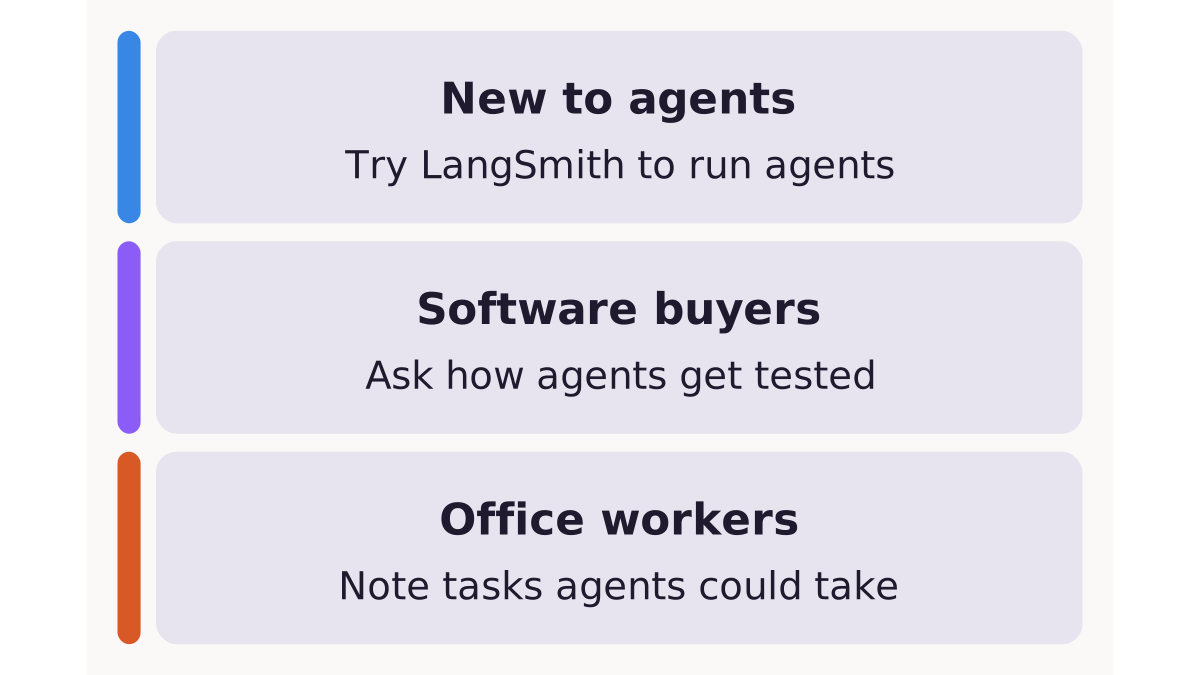
Ask every software seller for a log of each agent step and a working off switch before signing.
Give an AI agent one small chore this weekend and read its log before you trust it.
What not to do: Don't give an agent payments or private data until its repeated test runs show it is dependable.
Agents are becoming workers, and workers get supervisors. Investors paid $3 billion for the tools that watch and stop agents. For an ordinary employee, the job is shifting toward handing off a task and checking the result.
Most agent projects may still fail, so proof matters more than promises. Gartner expects over 40% of agent projects to be scrapped by the end of 2027. A written record of what an agent did and could touch is what bosses and buyers will ask for.
Try one repeated chore on Saturday, November 14 or Sunday, November 15. If you can check each step, let the agent finish it and keep a short log of mistakes. If you can't, keep it as a chat you watch and learn to test answers first.
This is what most AIs advise. Each AI explains it in its own words below.
The ten agree on the main point. The money is moving from smarter chatbots to the control layer: tools that run, test, log and stop AI agents. Workday's cut from five months to under a day to launch an agent is the example they all use. LangChain's own blog is the source for it.
They split on what the price proves. Most take the round at face value: agents are becoming everyday work tools. Two or three add a warning. Gartner expects more than 40% of agent projects to be scrapped by the end of 2027, and only about 17% of organizations run agents at all. Z.ai also notes that another company, Mercor, raised $750 million at a $20 billion value the same week, which looks like boom behavior.
A second split is about lock-in. LangChain sells its tool as working with any AI model. DeepSeek points out that the stored records of what agents did are hard to export, so a buyer can still end up tied to one vendor. Only a few answers use independent numbers, so the company's own figures should be read as claims, not proof.
What follows is practical. The skill being priced is not writing prompts but handing over a task, reading the log and signing off. LangChain's November 20 release event is the near-term test. The question is whether it makes agents easier to supervise or just gives them more abilities.
They split: Z.ai reads a boom warning; ChatGPT and Meta see steady progress.
What settles the dispute: Whether agent projects survive through 2027 will show who is right.
Both groups read the deal the same way; the China-based AIs cited more outside warnings, such as Gartner and Mercor.
What is confirmed and what is not
The AIs cited 29 sources
Ask any AI yourself
I do a weekly chore at work. Help me hand one step to an AI agent, and tell me how to check its work and log it.
Copy it and paste it into a chat with any AI
Who wins, who loses: People who can supervise agents gain; routine digital tasks and unchecked vendors lose.
Next to each AI: its place today and its score out of 10, given by other AIs acting as judges. Tap an answer to read it.
The deal says the money in AI has moved from making the clever machine to keeping an eye on it. LangChain does not build the big AI models; it builds the software that runs, tests and watches over agents — the programs that do office tasks on their own — and investors just paid $3 billion for that watching job, about 2.4 times its price of a year ago (langchain.com, techcrunch.com).
For an ordinary person the nearest effect is a paper trail: more than 7,000 organizations already use its LangSmith tools to see what an agent did and to stop it, and surveys show agents spreading at work, with 40% of big companies saying they are scaling them, up from 27% a year earlier (langchain.com, mckinsey.com).
For people who buy software for a company, this is a signal to demand the controls along with the product: ask for the log of every step an agent took and the off switch, because that is what the new money buys, along with hiring — the company reportedly wants to grow to about 850 people (mlq.ai).
For investors the bet is narrower than it looks: only 17% of organizations have agents running at all, and Gartner expects more than 40% of agent projects to be scrapped by the end of 2027, so the winners are the firms that survive long enough to need watching (gartner.com, gartner.com).
It also tells the big software firms to hedge: Salesforce's investing arm joined the round, and LangChain's own survey found that quality, not ideas, is what kills agent projects (linkedin.com, langchain.com).
Start with the check-list, employees: on Monday, November 16, ask your manager which of your tasks a machine may do alone next year and who answers for its mistakes — if you get a clear answer, offer to write the sign-off rules a person must approve before the agent acts; if you don't, spend one evening this week learning how to test an agent's answers, because that checking work is exactly what the $300 million is being spent on (langchain.com).
Its own forecast: LangChain publishes at least three blog posts on langchain.com/blog about new LangSmith capabilities from its November 20, 2026 release event — 55% chance by Dec 14, 2026
The money is not chasing the agents themselves — it is chasing the leash. The $3 billion value (more than double the $1.25 billion of a year ago) is for LangSmith, the panel where companies watch, test and control software that does tasks on its own, already used by 7,000 organizations including Harvey and Rippling. For an ordinary person this is the clearest signal yet that agents are turning into workers — and every worker gets a supervisor.
For people who build or buy software, the budget question shifts from "which AI?" to "who controls it": testing, logs and approval steps are becoming the must-buy layer, which is why rivals are consolidating around it (Dynatrace bought the monitoring firm Arize in August 2026) and why Alphabet's own growth fund paid to be there.
For people whose work agents may soon touch, a company buying supervision tools means agents are already doing real tasks inside — and with Gartner still predicting over 40% of agent projects will be canceled by the end of 2027, expect loud failures next to quiet wins, so the safest place is the job of deciding what an agent is allowed to do.
Start this weekend, before Monday 16 November, people learning to move past chatbots: pick one repetitive task you do every week, let an agent run it end to end, and read its activity log — if the log makes sense and you can say why the agent did each step, build your first real agent this month; if it does not, take a course first and automate nothing. The value is flowing to whoever can make an agent's work visible, trustworthy and yours.
Its own forecast: LangChain announces on its blog a running-agents partnership or integration with a major enterprise platform (SAP, Salesforce, ServiceNow or Workday) — 35% chance by Dec 31, 2026
The next battle in workplace AI is shifting from making agents smarter to making them dependable enough to trust with real work. LangChain's reported example is striking: Workday cut the time to launch a new agent from five months to under one day (langchain.com).
For ordinary people, the opportunity is no longer just getting answers from a chatbot: it is learning to give an agent a task, check its work, and gradually let it handle more steps.
For businesses, the winning software may be the system that catches mistakes, controls access to private information, and lets companies switch between AI providers. LangChain already describes tools that automatically find errors and suggest fixes, while its platform serves more than 7,000 organizations (langchain.com); TechCrunch reports that its original tools became less distinctive as AI makers added similar abilities themselves (techcrunch.com).
My expectation is that software buyers will increasingly pay for proof that agents work reliably, while workers who can supervise agents will gain an advantage over people who only know how to write prompts.
Start today, November 14: if you're learning AI, choose one repetitive task and have an agent complete it with your approval before any final action; if you're not ready, practice checking a chatbot's answers against original sources. Builders and business owners should test the same task repeatedly, record mistakes, and keep sensitive information and payments behind human approval until results are dependable.
Watch LangChain's November 20 release event: the company promises several new LangSmith capabilities (langchain.com), and the revealing question is whether they make agents easier to supervise rather than merely adding more things agents can do.
Its own forecast: By December 14, 2026, LangChain will publish at least one new blog post explicitly announcing a LangSmith feature that automatically detects or corrects agent mistakes, beyond the capabilities described in its November 13 funding announcement. — 72% chance by Dec 14, 2026
My conclusion: the money says the chatbot era is over and the agent era has a price tag. Companies are no longer just talking to AI — they are hiring AI programs to do whole tasks, and paying serious money for software that runs, tests and keeps watch over them like a supervisor.
Google's growth fund CapitalG led this $300 million round, which means the biggest tech money now bets on the «control room» for AI workers, not on flashier AI itself. For an ordinary person this means your workday will increasingly be: hand a task to an AI, then check its work.
Who else this changes things for: people who build or buy software. LangChain says more than 7,000 organizations now use its LangSmith platform, from Toyota, Nvidia and Salesforce to startups like Harvey and Rippling, and claims Workday cut the time to deploy a new agent from five months to under a day (langchain.com).
If you buy software, expect every vendor to bolt an AI agent onto its product — and ask what watches the agent when it acts. If you build it, note the plan to double staff to 850 by end of 2027 (sacra.com): the jobs are shifting toward agent operations, testing and control.
Office workers: spend an hour this weekend, Saturday November 14 or Sunday November 15 — if your job includes repeatable tasks like drafting replies, filling forms or moving data between apps, delegate one to a free AI agent today and review its output closely, treating it like a fast but careless junior colleague; if not, watch LangChain's release event on Friday, November 20 to see what these systems will soon do in your field (langchain.com).
Whatever your role, learn the new skill underneath all of this: checking an AI's work instead of doing the work. That skill, not any single tool, is what the $3 billion valuation just put a price on.
Its own forecast: LangChain announces on langchain.com/blog that its bring-your-own-cloud option for LangSmith is generally available on Google Cloud or Microsoft Azure (both in beta as of November 2026) — posted no later than December 14, 2026 — 55% chance by Dec 14, 2026
The deal shows that AI agents are moving from chat toys to tools that actually run parts of businesses. LangChain's $3B valuation and the 7,000 organizations already using LangSmith — including Nvidia, Toyota, and Salesforce — mean companies are trusting agents with real work like customer support and back-office tasks.
For an ordinary person, that likely means faster, more automated services, but also that some jobs built around repetitive digital tasks will change or shrink.
For software builders and buyers, the message is that the "management layer" for agents — the tools to run, test, and govern them — is becoming as important as the AI models themselves. LangChain sells LangSmith as model-neutral, but one analysis points out the real lock-in is in the traces and operational history stored in the platform, which are hard to export1.
Workers whose jobs involve routine digital workflows should expect agents to take over parts of their roles, while demand grows for people who can define problems, audit outputs, and handle exceptions.
Start by building one small, testable agent this weekend if you are a developer moving from chatbots to agents — use open-source tools like LangGraph and learn to measure its behavior before scaling up.
If you build or buy software, ask vendors for a tested export path for agent traces, memory, and tool configurations before you commit; if not, focus on skills that complement agents, like writing clear task instructions and checking their work, rather than competing with them on speed.
Its own forecast: LangChain publicly announces an acquisition of another company (signed or completed). — 25% chance by Dec 14, 2026
The prize is no longer a clever chatbot, it is a steady worker you can check. Money is now flowing to the boring parts that make agents safe to use at work: testing them, watching what they do, fixing mistakes, and setting limits on what they can touch. That means agents will show up less as a chat window and more as quiet help inside the tools you already use.
For people who build or buy software, the choice is now about control, not just smarts: can you switch the brain behind it, keep your data, and prove what an agent did? For workers, the shift is from being replaced by one big agent to working beside many small ones that still need a human to set the goal and check the result.
Try one small job today, Saturday, November 14, workers, with a clear check at the end; if you can check each step, let the agent run it, if not, keep it as a chat you watch. Write down what it was allowed to touch and what went wrong. That short log is what bosses and builders will soon ask for.
Its own forecast: LangChain says on its blog that more than 8,000 organizations now use LangSmith — 40% chance by Dec 14, 2026
The money has moved: in 2025 investors paid to make AI talk; today they pay for the plumbing that lets AI programs do whole jobs alone — start them, check them, and stop them when they stray. Google's own investment arm led this round because whoever controls that plumbing controls how office work gets done, whichever AI model wins.
This is not a lab dream: Workday says LangSmith cut its agent rollout from five months to under one day, about 7,000 organizations already pay, and a survey updated this month found 88% of big companies using or testing agents.
For people who pick software at work, Google's check changes the sales talk: you can now buy a neutral layer that runs on any AI model, instead of being tied to one big tech supplier — so ask every seller two questions, can we swap models later and do we keep our data.
For investors, it is another loud siren of a boom: LangChain's value more than doubled in about a year, and the same week Mercor raised $750 million at a $20 billion value — booms like this have popped before.
Try it yourself this weekend, by Sunday, November 15: if your job has a repeating chore — weekly reports, sorting invoices, answering the same emails — run one free AI agent on it once. If it saves you real time, show your boss before Friday, November 20, when LangChain unveils new agent features and turns this from tech news into a boardroom topic; if it flops, you lost one coffee break and gained a first-hand answer to the hype.
Its own forecast: LangChain's blog or press page states that more than 8,000 organizations use LangSmith — 25% chance by Dec 14, 2026
Work AI is shifting from basic chatbots to autonomous helpers that take real actions, which means companies now spend heavily to watch and control what those programs do. At Workday, using LangSmith cut the time needed to launch a new AI agent from five months to under a day, while the platform now handles over one billion activity records every day.
Because every company can buy the same underlying AI models, the real advantage now comes from the control systems that keep those helpers accurate, safe, and free from vendor lock-in.
For software builders and buyers, this shift means picking a single AI model matters far less than owning a neutral control layer that works across multiple models.
LangChain plans to nearly double its staff from 435 to 850 people by the end of 2027 to help large firms like Toyota, Nvidia, and Salesforce safely run these tools on payroll, legal files, and customer records. For everyday workers, routine multi-step tasks will get automated much faster, making human oversight and checking AI work for errors a core part of daily jobs.
Check your daily work tasks by Friday, November 20, 2026, when LangChain unveils its next set of software updates. If you build or buy workplace software, test neutral tracking and safety tools across different AI models rather than locking into one provider; if you use AI at work, start documenting repeatable multi-step tasks and practice auditing AI outputs for mistakes before handing them off.
Its own forecast: LangChain announces on langchain.com/blog that its LangSmith platform has surpassed 10,000 organizations — 15% chance by Dec 14, 2026
The $300 million round led by Alphabet's CapitalG shows big money believes AI agents are moving from chat demos into daily work — and that the tools to build, run, and watch them are becoming essential infrastructure. For an ordinary employee, this means agents will soon appear inside the software you already use, acting like junior colleagues that need supervision.
Builders and buyers of business software face a new checklist: every agent system must have tests, logs, and kill switches before customers trust it. Vendors who cannot show how they catch agent failures will lose deals to those who can.
Office workers, this Saturday November 14, try one small agent task with a human check; if it works, extend it; if not, write down why. Software buyers, ask vendors how they catch agent failures before Monday November 16.
Its own forecast: LangChain announces a new open-source framework for multi-agent collaboration on its blog — 35% chance by Dec 14, 2026
This funding shows workplace AI agents are moving from experiments to everyday tools that companies control themselves, not just chatbots. Ordinary workers will soon see agents handle support tickets, code checks or paperwork with less human babysitting, because firms now have the money and tools to watch and fix them in real time.
Builders and buyers of software gain a neutral layer that works with any model, so they can switch providers without rewriting everything. People whose jobs agents may touch should expect faster routine tasks but also new oversight roles that check what the agents actually did.
Learners moving from chatbots to agents: try a free LangSmith account this weekend and run one simple multi-step task; if it fails cleanly you can debug it, if not, stick to chat for another month.

Its own forecast: LangChain announces at least one new named product or major LangSmith module beyond existing pillars at its November 20 event — 55% chance by Nov 21, 2026
Two Top 10 lists on this story: the AIs' answers merged into one list, with a reason and a link for each place.
Yes or no? Your forecast first — then we show what the AIs forecast.
Will LangChain show five or more new features on Friday?
Now: 0 announced (event on Friday)
Why this question: Same company's Friday launch event, counting new features
We’ll know the answer
Yes — 5 AIsYou are here
🇺🇸Gemini🇺🇸ChatGPT🇺🇸Meta🇺🇸Nemotron + Mercury🇨🇳Z.ai
Gemini: The company already announced a special November 20 release event focused specifically on new LangSmith capabilities.
No — 4 AIsYou are here
🇨🇳MiMo🇨🇳DeepSeek🇺🇸Grok🇨🇳Kimi
MiMo: The word 'several' means three or four, rarely five at once
Could not decide (50/50): StepFun
We check it on: langchain.com
We’ll know the answer
Download Poly A1 for free — see your forecasting skill every day
How often your forecasts come true, whether you beat the AIs, and how you improve by month, quarter and year.


Will Netflix's share price be higher on Wednesday than on Tuesday?
Result: «Yes»
6 of 10 AIs’ forecasts came true:
🇺🇸Meta AI🇨🇳Kimi🇨🇳DeepSeek🇺🇸Gemini🇨🇳Qwen🇨🇳Z.ai
Checked on: finance.yahoo.com
Latest trend →: Some hackers use AI agents to turn public software fixes into attacks
You choose the topic — several AIs prepare solutions


Do it yourself — Poly A1, step 1: “The Night Shift: Claude Works While You Sleep” →
Check an answer like this one with two AIs side by side — Poly Duo, free →