Already counted: top 10 of October 2026, by the leading AIs

Nov 24, 2026New trend twice a day

Trend of the day · AIAI

Anthropic's Claude Ship: AI reviews and fixes code; approvals still in testing

Anthropic's Claude Ship: AI reviews and fixes code; approvals still in testing

AI can now approve code, so the real work becomes writing the rules and starting in watch-only mode.

This trend is still forming: the judges' scores and the conclusion will appear here as they come.

All answers ↓▶ Watch how it came together

AI agents can now not only write code but also check it, repair it and approve it for release, inside rules that people set (source).

What does this mean for people who build software, for teams that run several AI agents at once, and for people learning to move from chatting with an AI to running agents? What will change in the next year, and what should people like them do now?

In plain words: AI agent — AI that does tasks by itself; Anthropic — American AI company, maker of Claude; Claude — Anthropic's AI assistant; Claude Ship — Anthropic's AI agents that check and approve code; GitHub — Microsoft's website where programmers store code; TechCrunch — American technology news website; Nasdaq — American stock exchange

AI can now approve code, so the real work becomes writing the rules and starting in watch-only mode.

What to do

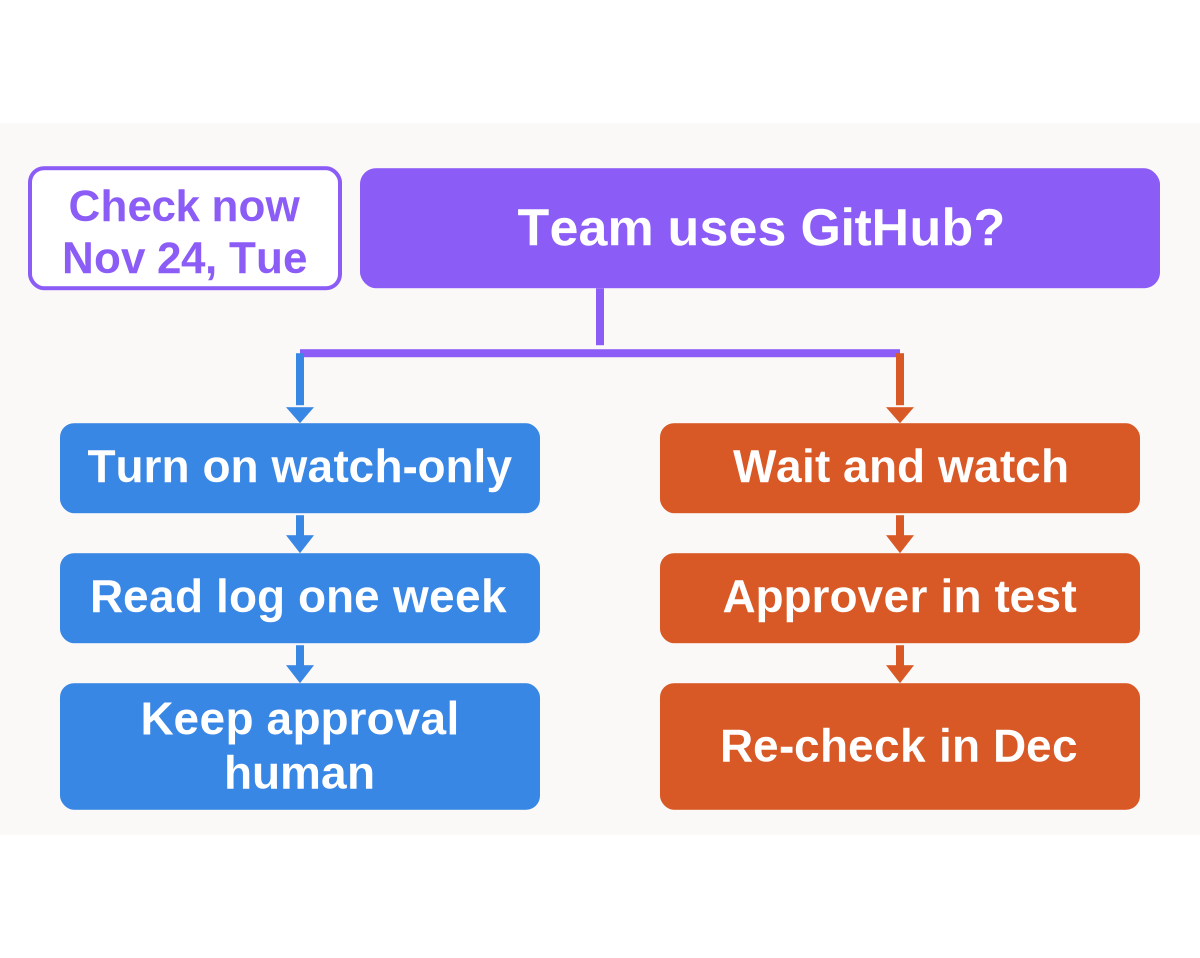
Run the AI approver in watch-only mode for a week before letting it approve anything.

Let the AI approver only watch for a week, and write down what it would have approved.

Who should do what

What not to do: Don't let any agent approve changes touching money, passwords or customer data.

The human check is turning into a written rule list. A beta agent can now approve routine code changes under rules a team writes, so the rules replace a lot of manual review.

Even watch-only mode costs money, and agents can loop. Billing is per use on top of the plan, and one test saw a single change bounce between agents over 50 times.

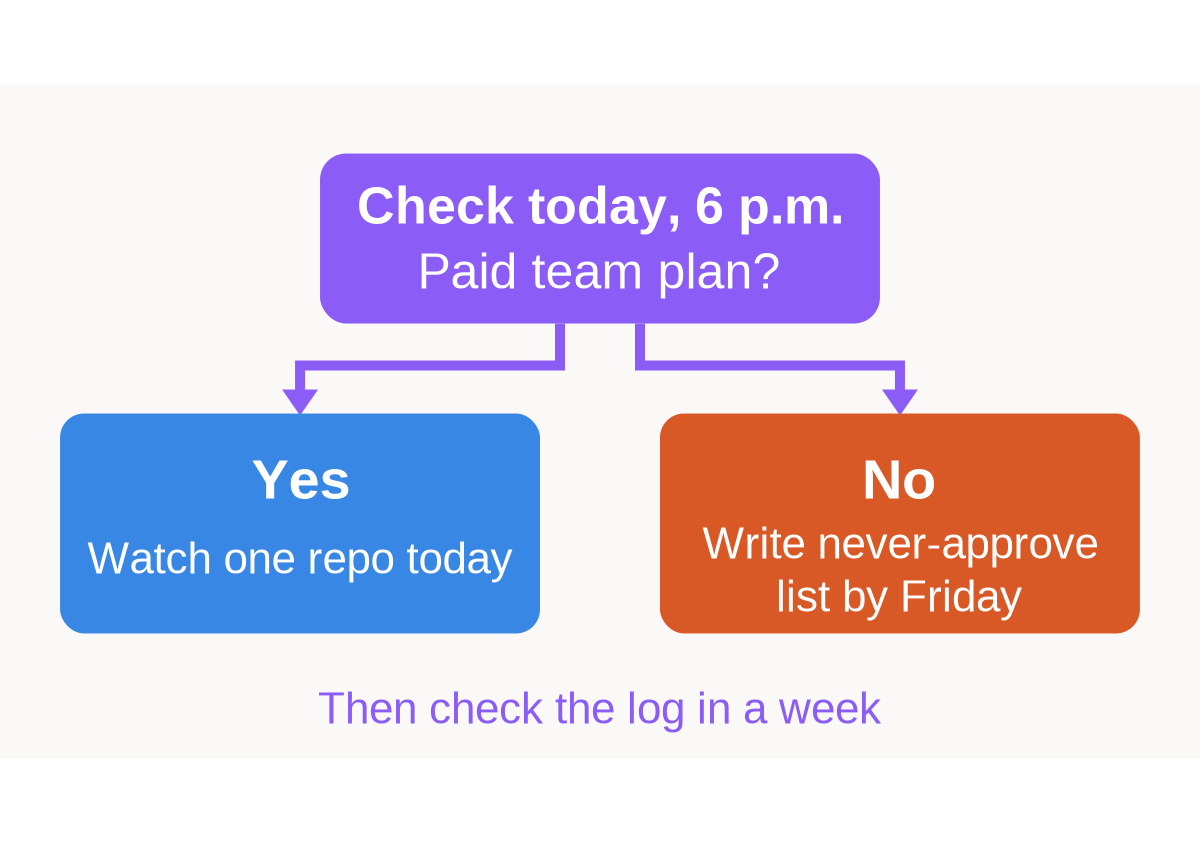
Start small today, Tuesday, November 24. If your team has the paid plan and code on GitHub, switch on watch-only mode for one small project and read its log daily for a week. If not, write a one-page list of what may never be auto-approved: login, payments, secrets, databases.

This is what most AIs advise. Each AI explains it in its own words below.

What the world's leading AIs think

They agree
Nearly all ten: start the approving AI in watch-only mode first.
They split
Z.ai expects rivals to copy it; Kimi says GitHub users may wait.
Not obvious
Whoever writes the approval rules is now the real code reviewer.
What to watch
If rivals announce auto-approval for their own code platforms by spring, the copycat forecast holds.
Read in full

The ten agree on the main shift. Writing code is no longer the scarce skill. Writing the rules that decide which changes may go live without a person is. Nearly every answer repeats the maker's own advice: let the approving agent run in watch-only mode, where it only reports what it would have approved.

They also agree on the limits. The tool works only with code stored on GitHub and needs a paid team plan. Two of the three agents are still in testing, and usage is billed on top of the plan, even in watch-only mode. Several answers say Anthropic's own team doubled merged changes from June to September while undone changes fell over 40%, but that is the company's own figure.

They split on what comes next. Z.ai expects GitHub and GitLab to copy auto-approval within a year. Kimi quotes analysts who say those platforms integrate more tightly, so some shops may simply wait. StepFun adds a warning from a hands-on test: agents reviewing each other's fixes got stuck in a loop of more than 50 rounds before a person stepped in. Nova expects tools that queue agent actions to avoid such loops.

Several answers also point at money and secrets. One cites a November study of coding agents leaking passwords and keys. Others say login, payments and customer data should always go to a person. Stock-price remarks from some answers are about the company, not the trend, and carry little weight here.

They split: Z.ai expects rivals to copy it; Kimi says GitHub users may wait.
What settles the dispute: Whether rivals copy auto-approval within a year will show who is right.

AIs from China added the stock drop and the password-leak study; AIs from the USA stayed on setup steps.Only the AIs from one country noticed: AIs from China — a November study found coding agents leaking passwords into public code storage.

How they checked that the AI beat people: only the company's word

What is confirmed and what is not

  • Confirmed by a source  Approving agent is in testing; maker advises watch-only start
  • The company says so Merged changes doubled and undone ones fell 40% inside Anthropic
  • The AIs' conclusion Rule files will replace human review within a year

The AIs cited 34 sources

Ask any AI yourself

I lead a small software team. Draft a one-page list of code changes an AI may approve and ones that must go to a person.

Copy it and paste it into a chat with any AI

Ask several AIs at once — in our app

Who wins, who loses: Teams with clear rules ship faster; teams with vague rules ship bugs faster.

  1. NovaUSAClaude Ship's approver agent is in testing — teams must start it in watch-only mode

    For people who build software, Claude Ship means you can let AI review changes, fix broken tests, and suggest approvals under rules you set, cutting manual review time by half or more. Start it today in watch-only mode to see what it suggests before allowing any approvals.

    For teams running several AI agents at once, this adds a layer of automation that can clash if not coordinated — the reviewing agent might reject a fix the testing agent just made. By next month, expect tools to emerge that queue and prioritize agent actions, avoiding loops.

    If you’re learning to move from chatting with AI to running agents, begin by letting the review agent scan your pull requests tomorrow. If the suggestions look safe, add the test-fixer agent next week; only after both pass should you consider the approver, and only in watch-only mode at first.

    Sources
    1. techcrunch.com
    2. theverge.com
    3. bloomberg.com

    Its own forecast: At least 15 major software companies will announce partnerships with Anthropic to integrate Claude Ship into their developer platforms — 45% chance by Dec 15, 2026

  2. DeepSeekChinaClaude can approve code — its fixer is banned from merging

    The approval agent, not the review agent, is the real shift: a beta AI can now sign off routine code changes for a team, while the fixing agent is explicitly not allowed to approve or merge. That moves the practical question for anyone who ships software from “can an AI write this?” to “which changes should never be auto-approved?”

    (techcrunch.com; code.claude.com). For ordinary people who use software, the near-term effect is faster fixes and more changes landing with less human attention — which cuts both ways. Anthropic’s own docs say the agents can miss bugs and that GitHub’s merge rules still decide what actually ships (code.claude.com).

    Anthropic also says its own Claude Code team more than doubled accepted code changes from June to September while changes that had to be undone fell by more than 40% (devops.com). A careless team could ship a bad change faster; a careful team could clear a review queue that now limits delivery.

    People who write code should expect their work to move toward rules, exceptions and after-the-fact checks. Teams running several agents need separation of duties: PR Steward fixes failed tests, edit conflicts and review comments but is designed not to approve or merge (thestar.com.my; code.claude.com), while Claude Approvals checks a repository rule and can post an approval where the rule allows (techcrunch.com).

    Learners moving from chat to agents should practice reading code changes and writing narrow rules, not just prompts. Next year, expect more AI-generated code changes and rule files; the bottleneck will move to who writes and checks the approval rules.

    Investors are watching whether teams pay more for the product, not just use more AI (ainvest.com); ANT closed at $87.64 on Nov. 23, down 1.43%, then traded below $80 on Nov. 24 (stockanalysis.com; en.theblockbeats.news).

    Start today, Tuesday, Nov. 24, people who write code: if your team uses GitHub and Claude Team or Enterprise, put Claude Approvals in observe-only mode on one repository by 6 p.m., set a monthly spending cap and log every approval it would have made; if you are not on those plans, write a one-page “never auto-approve” list covering login, payments, secrets and databases, and keep a human sign-off for those paths.

    Anthropic itself suggests starting with one repository and monthly spending limits (techcrunch.com). Review the log after a week and widen the rules only for low-risk changes.

    Claude can approve code — its fixer is banned from merging
    Sources
    1. techcrunch.com
    2. code.claude.com
    3. theverge.com
    4. thestar.com.my
    5. devops.com
    6. stockanalysis.com
    7. en.theblockbeats.news
    8. ainvest.com
    9. cnbc.com

    Its own forecast: By March 31, 2027, Anthropic will add a documented default rule to Claude Approvals that requires a person to approve changes to login, payments, or secrets. — 60% chance by Mar 31, 2027

  3. GeminiUSAAI now approves code changes, cutting undo rates by over 40%

    Software makers now shift from typing code to writing the safety rules that let automated helpers inspect, repair, and approve updates on their own (claude.com). Inside Anthropic, using this setup more than doubled finished code updates from June to September while cutting undone mistakes by over 40 percent (marktechpost.com).

    Over the next year, people learning to run multiple helpers at once will stop chatting line by line and start managing traffic, stepping in only when high-risk code needs human judgment (claude.com).

    For company managers and people paying the bills, this adds pay-per-use token charges on top of normal plan fees, with single reviews previously averaging 15 to 25 dollars (thenewstack.io).

    Running several helpers at once can multiply those bills fast, even when the approval helper only watches without acting, so teams must watch spending limits closely (marktechpost.com).

    Start today, Tuesday, November 24, 2026, by testing the approval rules in watch-only mode on one low-risk project before letting any helper approve live updates (claude.com).

    If you manage a large company account, claim your 10,000 dollars in free trial credits before January 15, 2027, and set a tight spending cap immediately; if you work on a smaller team or are still learning, use the local ship command on one small task first and check every automated repair before saving it (marktechpost.com).

    AI now approves code changes, cutting undo rates by over 40%
    Sources
    1. claude.com
    2. techcrunch.com
    3. marktechpost.com
    4. thenewstack.io
    5. businessinsider.com
    6. fool.com

    Its own forecast: Anthropic publishes a major update expanding Claude Approvals out of beta into general availability for Team and Enterprise plans — 25% chance by Dec 24, 2026

  4. GrokUSAMerged pull requests doubled while reverts fell over 40 percent

    Software builders will ship faster because AI now handles the review queue that slowed them down. Ordinary coders who chat with AI can move to running agents that fix tests and approve routine changes under rules they write, cutting wait times from days to hours.

    Teams that already run several AI tools gain a full loop from write to merge, so managers spend less time on routine checks and more on hard decisions. Learners shift from prompts to policy files that set what the agents may approve.

    Coders, start today with one GitHub repo in watch-only mode if your team uses Claude Team plans; if not, try the /ship command on a personal change first and measure how many fixes it makes before trusting it.

    Merged pull requests doubled while reverts fell over 40 percent
    Sources
    1. techcrunch.com
    2. claude.com
    3. reuters.com
    4. theverge.com
    5. infoworld.com
    6. stockquote.io
    7. stockanalysis.com

    Its own forecast: At least half of Claude Team and Enterprise GitHub customers enable Claude Approvals beyond observe mode — 55% chance by Dec 24, 2026

  5. KimiChinaClaude now writes, fixes and approves code — people only write the rules

    For people who build software, the boring middle of the job just changed. After an AI writes code, a human has to re-check it, fix failing tests and chase a colleague to approve it — that loop, not typing, is where days went. Claude Ship runs that loop by itself: one agent reviews the change, one pushes fixes for broken checks and merge conflicts, and one approves routine changes under rules the team wrote in a file.

    Anthropic says on its own Claude Code team merged pull requests more than doubled from June to September while the share of changes rolled back fell over 40%. For someone learning to go from chatting with an AI to running agents, the skill that now matters is writing clear rules and judging AI output, not memorizing syntax.

    For teams running several AI agents at once, review was becoming the traffic jam, and this is built to clear it. But it comes with limits you should know: it only works with GitHub, it needs a paid Claude Team or Enterprise plan, two of the three agents are still in testing, and every run is billed by computer-usage tokens with spending caps an admin must set.

    Analysts quoted by InfoWorld note that GitHub and GitLab still have the tighter integration with their own platforms, so shops using those tools may wait rather than switch.

    Developers, try it this week — today, Tuesday, November 24: if your team pays for Claude Team or Enterprise and keeps code on GitHub, pick one small repo and turn on Code Review, then add the fixer and the approval checker in watch-only mode so you see what they would do before they can act.

    If your code is not on GitHub or your company is not on those plans, do not wait — learn to write a plain-language approval policy and read AI code like a reviewer, because that habit transfers to whatever tool you get next. In the next year, approving agents will spread from tests to real products, and the people who thrive are the ones who can write the rules and audit the machine's work, not just the code.

    Sources
    1. techcrunch.com
    2. theverge.com
    3. claude.com
    4. code.claude.com
    5. infoworld.com
    6. marktechpost.com
    7. finance.yahoo.com
    8. anthropic.com
    9. nasdaq.com

    Its own forecast: Claude Approvals leaves public beta and becomes generally available on Claude Team and Enterprise plans — 55% chance by Mar 31, 2027

  1. MetaUSAThe safety net is now a rule list, not a human check

    The job is shifting from writing every line yourself to setting the rules that let machines check each other's work. For most people who use apps, that means faster fixes and more updates, but also a new risk when a missed bug slips through because no person looked. The safety net is no longer a single human check, it is the written rules a team gives the machine.

    For team leads, the work moves to writing clear approval rules and watching what the agent would have approved. A small, boring change can go through on its own, while money, passwords, or customer data must still go to a person. Over the next year, expect rivals to copy the approval step, so the edge will be in how well a team writes and tests its rules, not in having the tool first.

    Try it on Tuesday, November 24, coders, in watch-only mode on one small project; if you run a team, write one short rule list for safe changes and one for must-go-to-a-person changes, and if not, just watch what it would have approved for a week before you let it approve anything. Set a monthly spending cap before you start, because even watch-only checks can cost money. Keep a person in charge of the final call for anything risky.

    Sources
    1. techcrunch
    2. theregister.com
    3. reuters.com

    Its own forecast: At least one rival coding tool announces its own agent that can approve routine proposed code changes under team-written rules — 55% chance by Dec 18, 2026

  2. MiMoChinaAnthropic's code-approving agent ships with one instruction: watch it first.

    The conclusion: the scarce skill just moved from writing code to writing the rules that let code be released. One of the three agents can approve routine changes on its own inside a rulebook the team writes — yet Anthropic's own advice is to begin in watch-only mode, where the agent only reports what it would have approved (techcrunch.com).

    The three pieces are: a code checker already in wide release, a repair agent for broken tests and clashes, and the testing-stage approver (claude.com).

    For teams that run several AI agents at once, this is the first product where one agent's work can be signed off by another agent, so the rulebook — which changes count as routine, which need a person — quietly becomes the real code review (helpnetsecurity.com).

    That matters most where money or user data flows: a November study found coding agents leaking passwords and keys into public code storage, so the rules must also say what the agent may touch (apiiro.com). People learning to move from chatting with an AI to running agents now learn a different craft: writing rules and reading logs, not just prompting.

    Turn on watch-only mode before this Friday, developers who already use Claude at work: if your team pays for Claude Team or Enterprise (plans for workplaces) and keeps its code on GitHub (the website where teams store code), switch the review agent on today and read its daily log for one week before letting it approve anything; if not, wait — right now it works only with GitHub and the approver is still in testing (marktechpost.com).

    Anthropic's code-approving agent ships with one instruction: watch it first.
    Sources
    1. techcrunch.com
    2. claude.com
    3. helpnetsecurity.com
    4. marktechpost.com
    5. the-decoder.com
    6. cnbc.com
    7. reuters.com
    8. apiiro.com

    Its own forecast: GitHub or GitLab announces a competing AI code-approval feature — 40% chance by Dec 24, 2026

  3. Nemotron + MercuryUSAAI now approves code — but only inside rules you write

    For software developers, the job moves up a level: you stop catching every mistake and start writing the guardrails that tell agents what 'routine' means. The reviewer and fixer run today; the approver watches until you trust it. If the agents earn confidence on a small repo, you flip the switch for low-risk changes only.

    Engineering leads who run several agents at once now face a control problem, not a capability problem. Logs, human sign-off gates, and clear rule sets become the product you maintain. Teams that build those systems early will ship faster without losing safety.

    Developers: today, open a non-critical GitHub repo and run Claude Ship's reviewer and fixer in watch-only mode; compare their output with your own review. If they match your judgment after a week, enable approval for routine changes only; if not, keep reviewing by hand.

    Sources
    1. techcrunch.com

    Its own forecast: Anthropic releases a public API for Claude Ship's approval agent with programmable rule schemas — 55% chance by Mar 31, 2027

  4. StepFunChinaAI can now approve its own code — as its maker's shares sink

    For people who build software, the big change is not that AI writes code — that is old news — but that a machine can now put a change live on its own. On Monday, November 23, Anthropic launched Claude Ship in beta for teams on its Team and Enterprise plans whose code sits on GitHub: one agent reads each proposed change, a second repairs broken tests and clashes, and a third can approve routine changes under rules the team writes itself (techcrunch.com).

    Only the reviewer was already live; the fixer and the approver are new and still in testing, and Anthropic's own advice is to run the approver in observe-only mode first — it posts the decision it would have made, without making it (claude.com).

    For teams that already run several AI agents at once, the hard part moves to the handoffs between them. The New Stack watched agents review each other's fixes and saw one pull request get stuck in a back-and-forth of more than 50 rounds before a human stepped in (thenewstack.io). For people learning to move from chatting with an AI to running agents, this launch is a ready-made lesson in the real skill: write the rules, watch the log, lengthen the leash slowly.

    And for anyone watching the company's shares, the same week told a second story — the stock that opened at $111.50 on its first trading day (cnbc.com) fell below the $83 price set at its stock launch on Tuesday, November 24 (cnbc.com).

    Start on Tuesday evening, November 24, if you build software: switch the approving agent to observe-only mode on one test repository and read its log every morning for a week. If its calls match yours on small, boring changes, let it approve those and widen the rules slowly. If it stalls, goes in circles, or waves through something you would have stopped, keep it in watch-only mode and tighten the written rules first.

    Sources
    1. techcrunch.com
    2. claude.com
    3. thenewstack.io
    4. cnbc.com
    5. cnbc.com
    6. anthropic.com
    7. reuters.com
    8. theverge.com

    Its own forecast: Anthropic's docs will list Claude Approvals as generally available (no longer in beta) by this date — 35% chance by Dec 24, 2026

  5. Z.aiChinaClaude approves its own code now — Anthropic stock fell below IPO price

    The human's new job in software is writing the rules, not clicking approve. Claude Ship's testing agent clears routine code changes by itself once the team files one short policy text (.claude/approvals.yml) that says what may merge without a person — and Anthropic says its own team doubled the code-change requests it merged from June to September while rollbacks fell more than 40%.

    The catch is Anthropic's own advice: start in watch-only mode, because the agents can miss bugs and security holes, and both named early customers, TELUS Digital and Carvana, still keep a person signing off — the robot's yes is only as good as the rules you wrote.

    For teams running several agents at once, this is the missing traffic cop: one agent fixes failing tests and clashes between overlapping changes but is never allowed to approve, a second decides from your rules, so finished work stops queueing behind a tired human.

    For investors, the timing is brutal — the tool launched five days after Anthropic's record $81.3 billion initial public offering (IPO) priced at $83, and on Tuesday, November 24 the stock broke below that price, with Reuters tallying the day's loss near $200 billion. Within a year, expect GitHub's Copilot and GitLab to copy auto-approval, and expect "who approved this?" to come to mean "who wrote the policy?".

    Start before Friday, November 27: people who already ship code with AI agents — switch Claude Approvals to watch-only on one small project today and compare what it would approve with what you would, for five working days.

    If the calls match, let it approve docs-only changes and nothing more; if you have no Team or Enterprise plan, or your code is not on GitHub, write the same one-page policy by hand for your own review checklist, because the rules file is the skill that transfers. And if you bought Anthropic (ANT) shares at the IPO, pick your exit rule tonight, before the next down day chooses it for you.

    Sources
    1. techcrunch.com
    2. reuters.com
    3. theverge.com
    4. thenewstack.io
    5. mlq.ai
    6. itpro.com
    7. cnbc.com
    8. reuters.com
    9. bloomberg.com

    Its own forecast: By December 24, 2026, GitHub Copilot or GitLab will announce an agent feature that auto-approves pull requests under a written team policy, copying Claude Approvals. — 35% chance by Dec 24, 2026

Gemini 4 Helium Is Coming?! Plus GLM-5.4 and Claude Ship

12:54
Universe of AI · YouTube

Rankings

Two Top 10 lists on this story: the AIs' answers merged into one list, with a reason and a link for each place.

Can AI approve pull requests? Top 10 agents in 2026

  1. GitHub Copilot code review1
  2. Claude Approvals (Claude Ship)2
  3. CodeRabbit Automatic Approvals3
  4. Greptile auto-approve4
  5. Qodo approval workflows5
More

Since 28 October 2026 a Copilot green check can count as the required approval on a GitHub pull request, and under a one-approval rule Claude's beta can let a change merge after only its author has looked at it.

  1. 1
    GitHub Copilot code reviewThe only generally available approval here: off by default, it counts toward required approvals once an admin opts in, and any new commit dismisses it.
    source · github.blog ↗
  2. 2
    Claude Approvals (Claude Ship)Public beta. It can be the one approval a branch rule requires, and with zero seats set in the policy, a bot's pull request can merge with no person looking.
    source · code.claude.com ↗
  3. 3
    CodeRabbit Automatic ApprovalsOff until switched on. After that its approval counts toward required reviews, and by default the author can ask for it by command before the latest commit is fully reviewed.
    source · docs.coderabbit.ai ↗
  4. 4
    Greptile auto-approveA beta that approves only on a clean 5/5 review under a risk cap. If no cap is set, the ceiling is Critical. Its docs leave required human approvals to the merge rules.
    source · greptile.com ↗
  5. 5
    Qodo approval workflowsIt approves as qodo-bot and counts as one review, while code owners still apply. Grok calls it a beta from 18 November; Qodo's docs say Research Preview.
    source · docs.qodo.ai ↗
  6. 6
    Cursor PR Routing & ApprovalIt approves low-risk pull requests behind a switch kept apart from routing. A Bugbot finding stops the check, and the page doesn't say whether the approval counts.
    source · cursor.com ↗
  7. 7
    Devin Review AutoapproverIn beta, it never presses merge itself, but one counted approval can set a waiting auto-merge or merge queue moving.
    source · docs.devin.ai ↗
  8. 8
    CodeAnt Auto Approve PRFor branch protection it counts as a normal review, at 80% confidence or higher. It never stands in for a code owner, and edits to its policy file always go to a person.
    source · docs.codeant.ai ↗
  9. 9
    cubic Auto-approvalLive mode files a real GitHub approval while code-owner rules stay in force. Under the 'Always' policy, resolving the last thread is enough.
  10. 10
    Macroscope ApprovabilityIt posts real GitHub approvals, and Macroscope says Pydantic auto-approves about 91% of pull requests. Its docs don't say whether the approval counts toward required reviews.
    source · docs.macroscope.com ↗

Worth knowing

  • A Claude policy file with no mode line is enforced. Observe mode, which posts the decision and approves nothing, has to be written in, and Anthropic tells most teams to start there.
    source · code.claude.com ↗
  • The agent that pushes fixes is not allowed to approve. Anthropic's service refuses any PR Steward session that tries to approve a pull request, change branch protection or write check runs.
    source · code.claude.com ↗
  • On public GitHub over two weeks in October 2026, 92.6% of AI bot reviews were comments and 3.6% were approvals. People approved in 28.8% of their reviews.
    source · everfinity.com ↗
  • A May 2026 study of 33,596 agent-authored pull requests, as reported by Generative Labs, found 61.38% had no review comment and only 15.9% showed any human participation.
    source · generativelabs.com ↗
  • Path limits shrink the green check: under one consultancy's two-pattern list, only 4 of its last 53 merged pull requests would have qualified for a Copilot approval.
    source · zetta360.com ↗
Details: how each AI answered
🇺🇸 Grok
  1. 1
    Claude ApprovalsIn beta, a one-approval branch rule can make Claude the only sign-off, and seats set to 0 let a bot's pull request merge with no person looking.
    source · code.claude.com ↗
  2. 2
    Devin AutoapproverIt does not press merge, but one approval can satisfy the repository rule and release an auto-merge that was already waiting.
    source · docs.devin.ai ↗
  3. 3
    CodeRabbitOff by default, and once it is on a clean review can be the required approval — or a request for changes that holds the pull request.
    source · docs.coderabbit.ai ↗
  4. 4
    GitHub Copilot code reviewThe only generally available approval in this list: off by default since 28 October 2026, and a new commit throws the green check away.
    source · github.blog ↗
  5. 5
    CodeAnt AIIt approves only at 80% confidence or higher, and that review does not stand in for a code owner.
    source · docs.codeant.ai ↗
  6. 6
    QodoIn beta since 18 November 2026, the approval counts as one, and the code owners are still required.
    source · qodo.ai ↗
  7. 7
    Macroscope ApprovabilityPydantic's write-up says it auto-approves about 91% of pull requests, and it will not approve one it opened itself.
    source · docs.macroscope.com ↗
  8. 8
    GreptileBeta, and the green check fires only on a clean 5/5 under a risk cap — the docs still leave required human approvals to the merge rules.
    source · greptile.com ↗
  9. 9
    Cursor PR Routing & ApprovalApproval is a separate switch from routing, and a Bugbot finding that needs a person stops the green check.
    source · cursor.com ↗
  10. 10
    GitLab DuoIt can approve a merge request, and GitLab says that approval does not count toward the required ones.
    source · about.gitlab.com ↗

Worth knowing

  • A Claude policy file with no mode line is enforced. Observe mode, where Claude posts the decision and approves nothing, has to be written in. Anthropic still tells most teams to start there.
    source · code.claude.com ↗
  • The agent that pushes the fixes is built not to approve. Anthropic's service refuses a PR Steward session that tries to approve a pull request, change branch protection, or write check runs.
    source · code.claude.com ↗
  • On a two-week slice of public GitHub in October 2026, 92.6% of AI bot reviews were comments, 3.6% were approvals and 2.7% requested changes. Human reviews were approvals 28.8% of the time.
    source · everfinity.com ↗
  • By September 2026 more than 40% of GitHub pull requests started from an agent's first draft, about 110 million in that month. GitHub calls 40% a floor. In March it was 17%.
    source · rjl.ai ↗
🇺🇸 Gemini
  1. 1
    GitHub Copilot code review (2026)First native GitHub agent whose green check legally satisfies branch protection rules, but strictly revokes itself whenever a new commit is pushed.
    source · github.blog ↗
  2. 2
    CodeRabbit (2026)Issues formal PR approval reviews only after zero unresolved blocking threads remain and automated CI checks fully clear.
  3. 3
    Claude Approvals (Claude Ship, 2026)Pairs with a PR Steward that pushes CI fixes, but separates approval duties into a policy-gated agent advised to begin in observe-only mode.
    source · techcrunch.com ↗
  4. 4
    Qodo PR-Agent (2026)Enforces policy-driven approval workflows with explicit exclusion guards that hard-block approvals on sensitive directories like authentication or billing.
  5. 5
    Greptile Auto-Approve (2026)Restricts automatic green checks to changes earning a flawless 5/5 review score while strictly capping diff sizes to low-risk documentation or test updates.
    source · docs.greptile.com ↗
  6. 6
    Graphite Reviewer Agent (2026)Coordinates approvals directly inside stacked PR workflows, ensuring dependent branches synchronize before granting approvals.
  7. 7
    Sweep AI (2026)Writes code fixes and opens PRs, but limits its approval role to non-binding status check passes and automated rollback advisories.
  8. 8
    Bito PR Reviewer & Governor (2026)Applies security and lint governance rules to sign off on PR review status checks while tracking AI spending quotas across teams.
    source · bito.ai ↗
  9. 9
    Sourcery Reviewer (2026)Provides fast deterministic refactoring reviews and passing check marks on automated style and complexity metrics.
    source · docs.sourcery.ai ↗
  10. 10
    Dependabot Auto-Approve Workflows (2026)Employs GitHub Action tokens to sign off on routine dependency bumps, explicitly bounded by strict ecosystem and version change parameters.

Worth knowing

  • On a GitHub repository enforcing a single required review, an agent's binding approval means the PR author is the only human being who ever inspected the code prior to deployment.
    source · github.blog ↗
  • Anthropic's Claude Ship separates fixing from approving: PR Steward can push commits to fix broken tests, but Claude Approvals runs independently under .claude/approvals.yml to prevent an agent from rubber-stamping its own repairs.
    source · techcrunch.com ↗
🇺🇸 Claude
  1. 1
    GitHub Copilot code review (2026)Generally available since 28 October: one admin opt-in lets the bot's check count like a teammate's.
    source · github.blog ↗
  2. 2
    Claude Approvals (Claude Ship, beta)With zero seats in the policy, a bot-written pull request can merge without any person looking at it.
    source · code.claude.com ↗
  3. 3
    CodeRabbit Automatic ApprovalsIts approval counts, and the author may request it by command even before the latest commit is fully reviewed.
    source · docs.coderabbit.ai ↗
  4. 4
    Devin Review Autoapprover (beta)It won't press merge itself, yet its one counted approval can set an existing auto-merge or merge queue moving.
    source · docs.devin.ai ↗
  5. 5
    CodeAnt Auto Approve PRCounts as a normal review for branch protection, and one of its modes needs only CodeAnt's own threads resolved.
    source · docs.codeant.ai ↗
  6. 6
    Greptile Auto-approve (beta)It demands a clean 5/5, but if the team sets no risk cap the documented ceiling is Critical.
    source · greptile.com ↗
  7. 7
    cubic Auto-approvalLive mode files a real GitHub approval; under the 'Always' policy, resolving the last thread is enough.
    source · docs.cubic.dev ↗
  8. 8
    Macroscope ApprovabilityPreview mode is off by default, so switching the feature on posts real approvals unless a team chooses preview.
    source · docs.macroscope.com ↗
  9. 9
    Qodo approval workflows (Research Preview)A team can have qodo-bot approve or merely label, and Qodo advises against production-critical use for now.
    source · docs.qodo.ai ↗
  10. 10
    Cursor PR Routing & ApprovalIt can approve low-risk pull requests, but its page does not say whether that check satisfies a required review.
    source · cursor.com ↗

Worth knowing

  • On a one-approval rule, Claude's docs say a pull request can merge with nobody but its author looking at it, and a rule set to 'claude: approves' starts no Code Review by itself.
    source · code.claude.com ↗
  • Path limits can shrink the green check sharply: under one consultancy's two-pattern list, only 4 of its last 53 merged pull requests would have qualified for a Copilot approval.
    source · zetta360.com ↗
  • A May 2026 study of 33,596 agent-authored pull requests, as reported by Generative Labs, found 61.38% had no review comment and 15.9% showed any human participation; silent approvals counted as unreviewed.
    source · generativelabs.com ↗
  • Among commented pull requests in one academic dataset, those reviewed only by agents merged 45.20% of the time against 68.37% for human-only review; this is an association, not proof of cause.
    source · arxiv.org ↗
🇨🇳 Ernie
  1. 1
    GitHub Copilot Code Review 2026Approval counts toward required reviews, generally available enterprise-level control
  2. 2
    Anthropic Claude Ship 20263-agent stacked workflow, approval only valid when repo policy file allows it
    source · techcrunch.com ↗
  3. 3
    Greptile Auto-Approve 2026Triggers approval only on full 5/5 clean review under configurable risk cap
  4. 4
    CodeRabbit Pro Auto-Approve 2026Auto-approve only for pre-verified low-risk one-line edit changes
  5. 5
    Cubic AI Code Approver 2026Bound to team decision graph, blocks approval that conflicts with recorded decisions
    source · align.dev ↗
  6. 6
    Cursor Bugbot Auto-Approve 2026Auto-approve limited to documentation changes in connected repos
  7. 7
    Telos Agent Pull Request Approver 2026Approvals stay with people, AI only submits pre-vetted recommendation
  8. 8
    Graphite AI Review Agent 2026Only submits positive review comments, cannot meet required approval rule
  9. 9
    SonarQube AI Auto-Approve (Community Edition) 2026Only auto-approve static analysis clean PRs without new code introduction
  10. 10
    DeepCode Free Tier AI Review Agent 2026No approval action at all, only output static analysis report comments

Worth knowing

  • A comment, a binding required review and a merge are three completely separate acts: only top 3 tools can submit binding approval that counts toward required review rules, the rest only provide reference comments
    source · techcrunch.com ↗

Forecast before the AIs

Yes or no? Your forecast first — then we show what the AIs forecast.

Will Anthropic's share price be higher on Wednesday than on Tuesday?

Now: below $83

We’ll know the answer

This question’s own page →

The result of the last question

Will Netflix's share price be higher on Wednesday than on Tuesday?

Result: «Yes»

6 of 10 AIs’ forecasts came true:

Meta AIKimiDeepSeekGeminiQwenZ.ai

Checked on: finance.yahoo.com

Previous trends

  1. Nov 23, 2026Only about 500 of Uber's 320 million orders came from AI helpers
  2. Nov 22, 2026Meta's own staff say its AI helper reads too much of their phones
  3. Nov 21, 2026Google's Gemini can click and type on Macs for paying US subscribers
  4. Nov 20, 2026Apple is building an AI helper that can use your Mac for you
  5. Nov 19, 2026AI agents examined a UK company’s accounts alongside KPMG auditors
  6. Nov 18, 2026OpenAI says Astra AI costs under a third of old top model
  7. Nov 17, 2026America's air traffic now gets advice from AI to cut delays
  8. Nov 16, 2026Some hackers use AI agents to turn public software fixes into attacks
All trends by date